
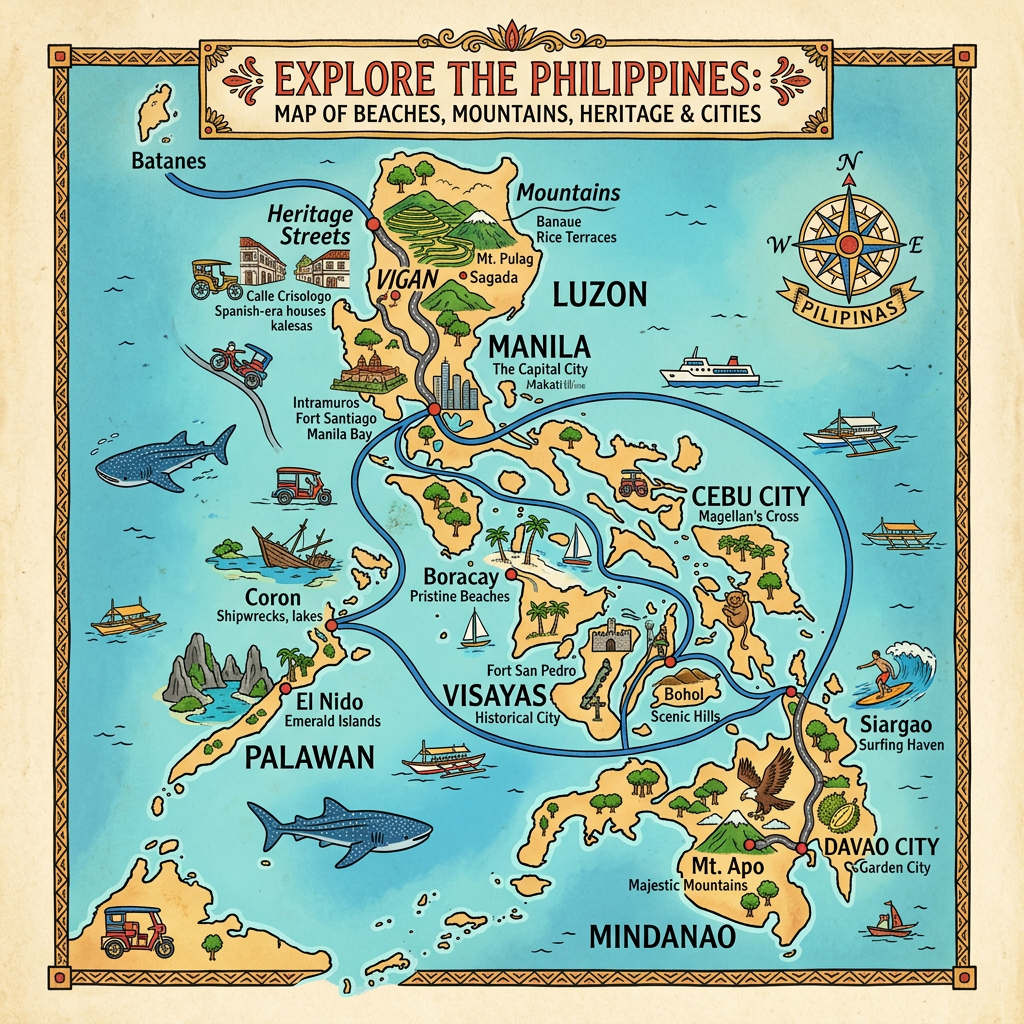
The Philippines has more than 7,000 islands, which makes answering a seemingly simple question surprisingly difficult: Where should you go?
The answer depends almost entirely on what you are looking for. Someone planning a two-week vacation may dream about the lagoons of Palawan or the white sand of Boracay, while someone considering retirement may care much more about hospitals, supermarkets, airports, internet service, and whether there are other expats nearby.
Then there are places such as Cebu and Bohol that can work for both. You can arrive as a tourist, fall in love with the lifestyle, and eventually begin wondering what it would be like to stay much longer.
This guide looks at some of the most popular areas of the Philippines from both perspectives. Some are primarily vacation destinations, some are established expat communities, and others offer an interesting combination of both.
Cebu: Perhaps the Best All-Around Introduction to the Philippines
If you wanted to choose one place that represents many different sides of the Philippines, Cebu would be difficult to beat. Cebu combines a major city, international airport access, shopping malls, private hospitals, restaurants, historical attractions, mountains, beaches, diving, and relatively easy access to other islands.
Cebu Province itself offers enormous variety. You can experience city life in Metro Cebu, stay near resorts on Mactan Island, see the sardine run in Moalboal, explore waterfalls in southern Cebu, visit Bantayan Island in the north, or use Cebu as a jumping-off point for Bohol, Negros, Siquijor, and other destinations. Cebu’s provincial tourism office describes the province as encompassing 51 cities and municipalities and highlights everything from Moalboal and Oslob to Bantayan and Malapascua.
For expats and retirees, Cebu has another major advantage: you do not have to completely give up big-city conveniences to live in the Visayas. That combination helps explain why Cebu repeatedly appears among popular Philippine retirement locations.
Best for: First-time visitors, retirees, expats, healthcare access, island hopping, city conveniences, beaches and people who want a little of everything.
Palawan: The Philippines You See in Photographs
If someone showed you a spectacular photograph of turquoise water surrounded by towering limestone cliffs and asked you to guess the country, there is a good chance the answer would be Palawan.
El Nido and Coron are two of the best-known destinations. El Nido is famous for lagoons, limestone formations and island-hopping, while Coron combines dramatic scenery with lakes, reefs and internationally known wreck diving. Puerto Princesa provides a more urban base and access to the Puerto Princesa Underground River.
Official Philippine tourism material continues to feature Palawan prominently among the country’s major destinations.
Palawan can also attract foreigners who want island living, but living somewhere like El Nido is very different from vacationing there. Retirees considering Palawan should think carefully about healthcare, transportation, infrastructure and how often they need to travel elsewhere.
Best for: Island hopping, spectacular scenery, diving, romantic vacations, nature and travelers seeking the classic tropical-island experience.
Boracay: The Famous Beach Vacation
Boracay is tiny compared with many Philippine destinations, but its reputation is enormous. White Beach remains one of the country’s signature attractions, with fine white sand, clear water, spectacular sunsets, restaurants, resorts and nightlife. The Department of Tourism describes Boracay as one of the world’s celebrated beach destinations and highlights sailing, snorkeling, water sports, dining and nightlife.
Boracay is primarily a vacation destination, although people certainly live there long-term. The trade-off is that island life in a major tourist destination can be more expensive and crowded than living in an ordinary Philippine city.
For a first Philippine vacation, however, Boracay is easy to understand. If your idea of a vacation is waking up, walking onto a beautiful beach, eating well and deciding whether today’s biggest decision is swimming or sailing, Boracay delivers.
Best for: Beach vacations, couples, sunsets, nightlife, resorts and first-time tropical travelers.
Bohol and Panglao: Vacation Destination With Long-Term Potential
Bohol offers one of the most interesting combinations of tourism and livability. Visitors come for the Chocolate Hills, tarsiers, countryside tours, diving, beaches and resorts, while Panglao provides the more traditional island-resort experience.
Bohol’s tourism office describes the province as a major tourist destination with beaches and resorts, particularly around Panglao and Anda.
For potential expats, the Tagbilaran-Panglao area offers something different from either Cebu City or a remote island. You can live near beaches and tourist amenities without necessarily feeling completely isolated, while Cebu is relatively nearby when you need a much larger urban center.
The important consideration for an older retiree is healthcare. Routine needs may be manageable locally, but someone who requires frequent specialist care should investigate whether traveling to Cebu for more complex treatment would become inconvenient.
Best for: Beaches, diving, couples, slower island living, nature and retirees who want to live closer to the water.
Siargao: Surfing, Island Life and a Younger International Crowd
Siargao built its international reputation around surfing, particularly Cloud 9, but it has grown into much more than a surf destination. Cafés, restaurants, island-hopping, lagoons, beaches and an international traveler community have transformed areas around General Luna.
Official Philippine tourism resources continue to list Siargao among the country’s most popular destinations.
Siargao tends to appeal especially to younger expats, digital nomads, surfers and people seeking a laid-back island lifestyle. A retiree could certainly love it, but someone prioritizing major hospitals and big-city infrastructure might prefer Cebu or another urban center.
Best for: Surfing, younger travelers, digital nomads, island lifestyle, cafés and adventure.
Dumaguete: One of the Classic Expat Retirement Choices
Dumaguete is different from Boracay, Palawan or Siargao because its appeal is less about being a world-famous vacation destination and more about everyday livability.
The city has long attracted foreign retirees because it offers a smaller-city environment, waterfront setting, universities, restaurants, English-speaking residents and an established expat community. Recent retirement coverage continues to identify Dumaguete as one of Asia’s attractive budget-friendly retirement destinations.
Another advantage is location. Dumaguete can serve as a base for trips around Negros Oriental, and nearby destinations such as Apo Island and Siquijor make weekend travel relatively easy.
Dumaguete will probably feel too small for someone who wants the shopping, hospitals and entertainment of Manila or Cebu. For someone who wants a slower retirement without completely disappearing into a remote provincial area, that smaller scale may be exactly the attraction.
Best for: Retirees, long-term expats, relaxed living, smaller-city life and people seeking an established foreign community.
Metro Manila: The Philippines at Full Speed
Metro Manila is enormous, busy, complicated and often misunderstood by visitors who think of it as one single city. Makati feels very different from BGC, which feels different from Quezon City, Pasay, Alabang and the many other communities making up the metropolitan area.
For tourists, Manila offers history, restaurants, nightlife, museums, shopping and easy connections to the rest of the country. Intramuros provides a look at the country’s Spanish colonial past, while Makati and BGC show a very modern side of the Philippines.
For expats, Manila offers something difficult to duplicate elsewhere: access to many of the country’s leading hospitals, international businesses, restaurants, shopping and services. The trade-offs are obvious—traffic, congestion, higher housing costs in premium areas and the intensity of living in one of Asia’s major metropolitan regions.
Someone who wants tropical retirement without giving up big-city life may love Manila. Someone dreaming about a quiet beach probably will not.
Best for: Urban expats, healthcare, business, international dining, shopping, nightlife and people who enjoy major cities.
Davao: Big-City Living in the South
Davao City gives expats another major-city option without living in Metro Manila or Cebu. It offers shopping, hospitals, restaurants, universities and an airport while also providing access to beaches, mountains and other parts of Mindanao.
Samal Island sits just offshore and gives Davao residents relatively easy access to beaches and resorts. Mount Apo and other natural attractions make the surrounding region appealing to travelers who enjoy outdoor activities.
For long-term residents, Davao can offer an interesting balance between city conveniences and southern Philippine living. It is farther from the country’s major international gateways than Manila and Cebu, however, which may matter to someone who frequently flies overseas.
Best for: Expats, retirees, city living, Mindanao exploration, nature and people who want a major city outside Manila or Cebu.
Iloilo: A City More Foreigners Should Consider
Iloilo does not receive the international attention of Boracay or Palawan, and that is part of its appeal. It offers a modern city, growing business districts, shopping, hospitals, restaurants and a strong regional identity without the overwhelming scale of Metro Manila.
For tourists, Iloilo provides heritage architecture, churches, food and access to other parts of Western Visayas. It can also serve as a gateway for exploring destinations such as Guimaras.
For expats, Iloilo is particularly interesting because it offers many of the things necessary for everyday life without being dominated by foreign residents or mass international tourism. Current retirement guides increasingly include Iloilo among the country’s alternatives to the traditional Cebu-Dumaguete-Manila choices.
Best for: Retirees, food, heritage, manageable city living and people looking beyond the most obvious expat destinations.
Baguio: The Philippines Without the Tropical Heat
Baguio surprises many first-time visitors because it does not feel like the tropical Philippines they imagined. Its elevation produces a noticeably cooler climate, and the surrounding mountains give the area a completely different character from Manila, Cebu or Davao.
Baguio has long been known as the country’s Summer Capital. Visitors come for the cooler weather, mountain scenery, parks, markets and food, while some foreigners consider it precisely because they like the Philippines but dislike relentless tropical heat.
The downside is that Baguio can become crowded, particularly during holidays and peak travel periods. It is also far from the beach lifestyle many retirees imagine when they think about moving to the Philippines.
Best for: Cooler weather, mountain scenery, longer stays and people who like the Philippines but not extreme heat.
Clark and Angeles City: Convenience and an Established Foreign Presence
Clark and nearby Angeles City have a long history of interaction with Americans and other foreigners because of the former U.S. Clark Air Base. Today, the area has changed considerably, with Clark developing as an aviation, business and economic center.
For expats, the attraction includes Clark International Airport, modern development, shopping, restaurants and access to Central Luzon. It also provides relatively straightforward access toward Subic, Manila and northern Luzon.
This is not the Philippine island lifestyle that appears on travel posters. For someone actually living in the country, however, convenience can eventually become more important than postcard scenery.
Best for: Long-term expats, airport access, Central Luzon, retirees and people who prefer infrastructure over island isolation.
Subic Bay: Another Longtime Expat Area
Subic shares some of Clark’s historical connection with the United States because of the former U.S. naval base. The Subic Bay Freeport area has a more organized, spacious feel than many densely populated Philippine cities and continues to attract some foreign residents.
Beaches and outdoor activities are nearby, while Manila and Clark remain accessible. For retirees who want an established area with a history of foreign residents but do not want to live in Metro Manila, Subic deserves consideration.
It is not as famous among international vacationers as Boracay or Palawan, but that distinction illustrates an important point: the best place to vacation and the best place to live are not necessarily the same place.
Best for: Retirees, longtime expats, former military families, Central Luzon access and a quieter alternative to Metro Manila.
Tagaytay: A Popular Escape From Manila
Tagaytay is popular partly because of what it is and partly because of where it is. Its elevation provides cooler temperatures, and its famous views toward Taal Volcano make it a favorite getaway from Metro Manila.
Restaurants, hotels, cafés and vacation homes make the area attractive for weekends. Some retirees also consider living there because it offers a cooler environment while remaining within reach of the capital region.
The trade-off is that weekend and holiday traffic can become significant, and anyone considering long-term retirement should examine healthcare access and transportation rather than judging the area solely from a relaxing weekend visit.
Best for: Weekend vacations, cooler weather, couples, food trips and people wanting to remain within reach of Manila.
Which Places Are Best for a Vacation?
For someone visiting the Philippines for the first time, I would think about experiences rather than trying to see as many islands as possible.
If your priority is spectacular scenery and island hopping, consider Palawan. For an iconic white-sand beach vacation, choose Boracay. For surfing and a younger island atmosphere, consider Siargao, while Bohol combines beaches with inland attractions.
For the broadest introduction to the country, Cebu may be the strongest choice because you can combine city life, history, beaches, diving and side trips within one vacation. Central Visayas, with Cebu at its center, has historically been the country’s leading region for international tourist arrivals.
Which Places Are Best for Expats and Retirees?
For long-term living, I would look at a different set of priorities.
Cebu is one of the strongest all-around choices if access to healthcare, airports, shopping and other expats matters. Dumaguete is attractive for a smaller and more relaxed retirement environment, while Iloilo deserves attention from people who want a manageable city that is not dominated by expat tourism.
Davao provides another major-city option, while Clark and Subic can appeal to foreigners who value infrastructure and familiarity. Metro Manila, particularly areas such as Makati and BGC, makes sense for people who prioritize sophisticated healthcare and big-city conveniences over low costs and quiet living.
The important point is that there is no single “best” expat city. The right answer depends on your health, budget, personality and preferred lifestyle.
Vacation There Before You Decide to Live There
If you are considering retirement in the Philippines, use your vacations as research.
Instead of spending three weeks at one resort, spend several days in places you might realistically live. Stay in Cebu City, Dumaguete, Iloilo, Davao, Clark or another location you are considering and try to experience ordinary life.
Go grocery shopping. Visit a mall. Walk around the neighborhood. Look at apartments. Check the nearest hospital. Use local transportation. See what the area feels like at night.
Then take your beach vacation.
That combination allows you to enjoy the Philippines while also learning whether it could become your home.
Final Thoughts
One of the great advantages of the Philippines is that you do not have to choose between only one kind of lifestyle. The country can offer a condominium in a modern business district, a small apartment in a relaxed university town, a house near the beach, a cooler mountain climate or an island where shoes begin to feel optional.
For vacations, places such as Palawan, Boracay, Bohol, Siargao and Cebu deserve their international reputations. For long-term expat life, Cebu, Dumaguete, Metro Manila, Iloilo, Davao, Clark and Subic are worth serious consideration.
Somewhere like Cebu or Bohol can even blur the line between the two.
That is why one of the best ways to explore the Philippines is not to ask, “What is the best place?”
Ask instead:
“What kind of life do I want when I get there?”
Once you know that, choosing where to begin becomes much easier.