
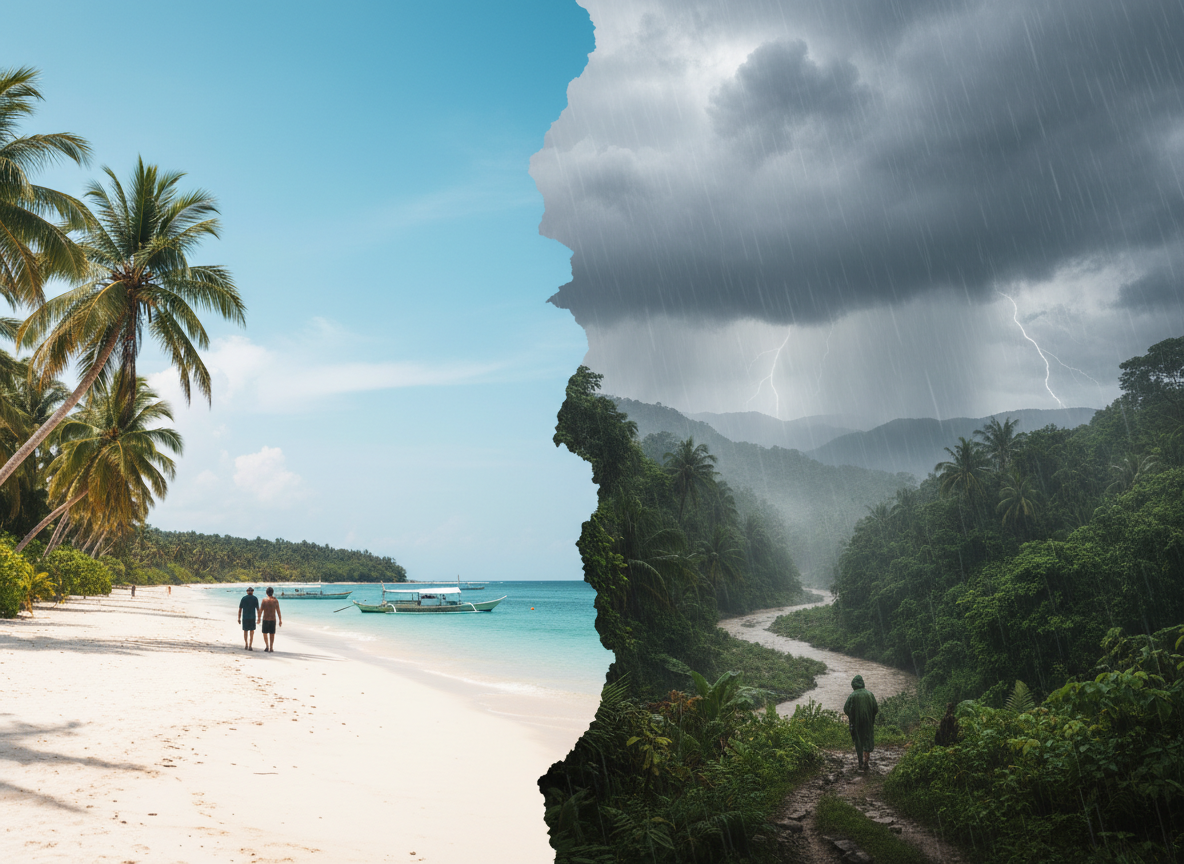
One of the biggest adjustments when moving to the Philippines is the weather.
If you’re coming from the United States, Canada, Europe, or another country with four distinct seasons, the tropical climate can take some getting used to.
There is no snowy winter.
There is no traditional autumn.
And in most parts of the country, you will never need a heavy winter coat.
Instead, life in the Philippines revolves more around heat, humidity, rain, monsoon winds, and tropical storms.
But there is one important thing to understand before planning your move:
The Philippines does not have exactly the same weather everywhere.
The country stretches across thousands of islands, and rainfall patterns can vary greatly between Luzon, the Visayas, and Mindanao.
Some areas have a very noticeable dry and rainy season. Others receive rain throughout the year.
So rather than thinking of Philippine weather as one single climate, it is better to think of it as a collection of tropical climates.
Here is a month-by-month look at what you can generally expect.
Understanding the Philippine Climate
The Philippines has a tropical and maritime climate.
That generally means:
- Warm temperatures throughout the year
- High humidity
- Frequent rainfall
- Tropical thunderstorms
- Seasonal monsoon winds
- The possibility of tropical cyclones
PAGASA, the Philippine government’s weather agency, commonly divides the year into a cooler dry period, a hot dry period, and a rainy season, although the timing and intensity vary depending on location.
For much of western Luzon and other areas with a pronounced seasonal pattern, the drier months generally occur from around November through April, while wetter conditions become more common during the rest of the year.
Other parts of the country, particularly eastern-facing areas, may receive substantial rainfall throughout the year.
January: One of the Most Comfortable Months
January is often one of the most pleasant months of the year.
Temperatures are generally cooler than they will be later in the spring, especially during mornings and evenings.
In places such as Manila, Cebu, and many other lowland cities, the weather will still feel warm to someone coming from a cold climate.
But compared with April or May, January can feel wonderfully comfortable.
What to Expect
- Warm days
- Cooler evenings and mornings
- Lower humidity than the hottest months
- Generally favorable travel conditions in many areas
- Occasional rain depending on region
Northern mountain areas such as Baguio can become surprisingly cool at night.
Good Month For
- Exploring cities
- Island trips
- Outdoor activities
- Moving into a new apartment
- Walking and sightseeing
For many newcomers, January is one of the easiest months to adjust to Philippine weather.
February: Warm, Dry, and Comfortable
February is another excellent month for travel and outdoor life.
Much of the country is still experiencing relatively dry conditions, and temperatures have not yet reached the intense heat associated with late March, April, and May.
What to Expect
- Plenty of sunshine
- Generally comfortable mornings
- Warm afternoons
- Less rain in many western areas
- Good beach weather
February can be especially pleasant for retirees who enjoy walking, sightseeing, golf, beaches, or outdoor dining.
Good Month For
- Beach trips
- Exploring neighborhoods
- Hiking
- Island hopping
- Longer road trips
If you are visiting the Philippines to decide whether you want to move there, January or February can provide a very pleasant first impression.
March: The Heat Begins to Build
March is when many residents begin noticing the transition toward hotter weather.
Days become warmer, humidity starts becoming more noticeable, and the midday sun can become intense.
You may quickly understand why many Filipinos prefer running errands early in the morning or later in the afternoon.
What to Expect
- Increasing temperatures
- Strong sunshine
- Generally dry weather in many areas
- Hotter afternoons
- Increasing need for air conditioning or fans
Living Tip
If you’re newly retired, consider adjusting your schedule to the climate.
Walk early.
Run errands before lunch.
Relax during the hottest part of the afternoon.
Go back out in the evening.
Living with the climate instead of fighting it can make life much more comfortable.
April: Usually One of the Hottest Months
April can be very hot.
This is the time of year when many residents start planning trips to beaches, swimming pools, mountain areas, or air-conditioned shopping malls.
Holy Week also occurs during March or April depending on the year and is one of the most important holiday periods in the Philippines.
Travel can become extremely busy during that time.
What to Expect
- Intense afternoon heat
- Strong sunshine
- High humidity
- Hot nights in some areas
- Increasing thunderstorms in some regions
Good Month For
- Beach resorts
- Swimming
- Mountain escapes
- Early-morning activities
Retirement Tip
If you are sensitive to heat, consider housing with good ventilation and reliable air conditioning.
Electricity costs can increase when air conditioning runs frequently.
May: Hot, Humid, and Changing
May often begins hot and humid, but weather patterns may start shifting as the rainy season approaches in parts of the country.
Afternoon thunderstorms become more common.
A day can begin bright and sunny and end with heavy rain.
What to Expect
- Hot temperatures
- Increasing humidity
- Afternoon thunderstorms
- Changing weather patterns
- Occasional heavy rain
This is a month when carrying a small umbrella starts becoming a good habit.
Travel Tip
Don’t automatically cancel an entire day because rain is forecast.
Tropical rain can be intense but brief.
Sometimes the sky clears shortly afterward.
June: Rainy Season Begins in Many Areas
June often marks the transition into wetter weather across much of the country, particularly areas influenced by the southwest monsoon, known locally as Habagat.
Habagat can bring moist air and prolonged rain to western portions of the Philippines.
What to Expect
- Increased rainfall
- Cloudier days
- Thunderstorms
- High humidity
- Occasional flooding
- Rougher seas during periods of strong monsoon weather
For people living in Metro Manila, parts of Luzon, and western sections of the country, June can feel noticeably wetter than the previous months.
Living Tip
Before renting a home, ask whether the neighborhood floods.
A beautiful apartment at a great price becomes much less attractive if the street becomes impassable during heavy rain.
July: Wet Weather and Increasing Tropical Cyclone Activity
July is firmly within the wetter part of the year for many locations.
It is also the beginning of the period when tropical cyclone activity becomes particularly important.
PAGASA reports that the peak of the Philippine typhoon season generally runs from July through October.
What to Expect
- Frequent rain
- Thunderstorms
- Humid conditions
- Possible tropical cyclones
- Rough seas
- Occasional flooding
This does not mean it rains continuously every day.
There may still be beautiful sunny mornings and entire dry days.
But you should expect your plans to remain flexible.
Retirement Tip
Keep a basic emergency supply at home:
- Drinking water
- Flashlights
- Batteries
- Power banks
- Medication
- Shelf-stable food
You may rarely need it, but having it provides peace of mind.
August: Rain, Monsoon Weather, and Flexible Plans
August is another wet month in many regions.
Periods of southwest monsoon rain can affect western Luzon and other western-facing areas, sometimes even when a tropical cyclone is far from your location.
A distant storm can strengthen monsoon winds and produce heavy rainfall hundreds of kilometers away.
What to Expect
- Heavy rain at times
- Cloudy periods
- High humidity
- Flooding in vulnerable locations
- Possible tropical cyclones
- Ferry or flight disruptions during severe weather
Good Month For
This can actually be a wonderful time for slower travel.
Tourist destinations may be less crowded, and tropical landscapes can be extremely green.
Just build flexibility into your schedule.
September: Still Deep in Typhoon Season
September is another month when tropical weather deserves attention.
Because July through October is the peak tropical cyclone period, travelers and residents should regularly follow PAGASA forecasts.
What to Expect
- Rain
- Tropical storms or typhoons
- Humidity
- Occasional sunny stretches
- Possible transportation disruptions
Important Point
A typhoon affecting northern Luzon does not necessarily mean dangerous weather in Cebu or Davao.
The Philippines is geographically large.
Always check the forecast for your actual location rather than assuming the entire country experiences the same weather.
October: Transition Month
October can still experience significant tropical cyclone activity.
However, as the month progresses, some parts of the country begin transitioning toward drier conditions.
Weather can be unpredictable.
One week might be sunny.
The next may bring days of heavy rain.
What to Expect
- Continued tropical cyclone possibility
- Periods of heavy rain
- Increasing sunny stretches
- Warm temperatures
- High humidity
Good Month For
Flexible travelers who do not mind changing plans when necessary.
November: Weather Begins Improving in Many Areas
November often brings improving conditions to western portions of the Philippines.
Rainfall may decrease and temperatures begin becoming slightly more comfortable.
It is also the beginning of the Christmas season in full force—although anyone living in the Philippines will quickly discover that Christmas decorations often appear much earlier.
What to Expect
- More comfortable temperatures
- Increasingly dry weather in many areas
- Some tropical cyclone risk remains
- Pleasant evenings
November can be an excellent time to travel, particularly later in the month.
December: One of the Best Months of the Year
December is a favorite month for many residents.
Temperatures are typically more comfortable, evenings can feel cooler, and holiday celebrations are everywhere.
In much of the western Philippines, conditions are generally drier than during the middle of the year.
What to Expect
- Comfortable tropical temperatures
- Cooler nights
- Lower heat stress
- Plenty of holiday activity
- Generally good travel conditions in many areas
Good Month For
- Family visits
- Island trips
- Outdoor dining
- Walking
- Festivals
- Exploring new cities
December through February is often one of the most enjoyable periods for people who prefer slightly cooler weather.
When Is Typhoon Season?
Tropical cyclones can occur during different times of the year, so there is no absolute “safe” month.
However, PAGASA says the peak typhoon season is generally July through October, when a large percentage of tropical cyclones affecting the region develop.
On average, around 20 tropical cyclones form or enter the Philippine Area of Responsibility each year, with roughly eight or nine crossing the Philippines.
That sounds intimidating, but the impact is not evenly distributed.
Some areas experience substantially more tropical cyclone activity than others.
Not Every Part of the Philippines Has the Same Typhoon Risk
This is extremely important when choosing where to live.
Eastern and northern areas exposed to the Pacific tend to experience greater tropical cyclone activity.
Areas farther south generally experience fewer direct typhoon strikes, although they can still receive heavy rainfall and severe weather.
This is one reason some retirees compare locations such as Cebu, Dumaguete, and Davao not only for cost of living but also for climate and storm exposure.
No location is completely free from weather risks.
But geography matters.
Manila Weather
Metro Manila generally has a noticeable seasonal pattern.
Expect:
December through February: More comfortable and generally drier.
March through May: Increasingly hot.
June through October: Wetter, with southwest monsoon rainfall and tropical cyclone effects possible.
November: Transition toward drier conditions.
Flooding can affect certain neighborhoods, so location matters greatly when renting.
Cebu Weather
Cebu’s weather can differ from Manila’s.
Temperatures remain tropical year-round, but rainfall patterns are often less sharply divided into dry and wet seasons than in western Luzon.
Rain can occur throughout the year.
Cebu can still be affected by tropical cyclones, though the exact risk varies from year to year.
One advantage is that weather frequently varies across the island, so conditions in Cebu City may differ from northern or southern Cebu.
Davao Weather
Davao is often attractive to retirees concerned about typhoons because it lies farther south than many commonly chosen destinations.
Direct typhoon strikes are generally less frequent than in northern and eastern portions of the Philippines.
However, Davao still experiences:
- Heavy rainfall
- Thunderstorms
- High humidity
- Flooding in vulnerable areas
- Hot tropical temperatures
Less typhoon exposure does not mean no weather risk.
Baguio Weather
Baguio is completely different.
Because of its elevation, temperatures are much cooler than in Manila, Cebu, or Davao.
You may actually want:
- A light jacket
- Long pants
- Blankets at night
Baguio also receives substantial rainfall, particularly during the wetter months.
If you love the Philippines but struggle with tropical heat, Baguio deserves consideration.
What About El Niño and La Niña?
Weather patterns can change significantly from one year to another.
Two major influences are El Niño and La Niña.
El Niño can contribute to hotter and drier conditions in parts of the Philippines.
La Niña can contribute to wetter conditions and, historically, can increase tropical cyclone activity later in the year.
That means a month-by-month guide describes typical patterns—not guarantees.
Before traveling or relocating, always check current PAGASA seasonal forecasts.
Best Months to Visit the Philippines
For many travelers, the most comfortable period is approximately:
December through February
Benefits include:
- Cooler temperatures
- Generally favorable weather in many tourist areas
- Less oppressive heat
- Excellent conditions for sightseeing
However, this is also a popular travel season.
Hotels and flights may cost more around Christmas, New Year, Chinese New Year, and major festivals.
Best Months to Move to the Philippines
If you have flexibility, January or February can be excellent months for relocating.
The slightly cooler weather makes it easier to:
- Apartment hunt
- Walk neighborhoods
- Move belongings
- Shop for furniture
- Set up utilities
- Explore your new community
Moving during intense April heat or heavy monsoon rain can make an already stressful international move more difficult.
Best Months for Budget Travel
The wetter months can sometimes offer excellent travel opportunities.
Hotels may have promotions.
Popular beaches may be quieter.
Flights can sometimes be cheaper.
The trade-off is flexibility.
A ferry trip or island tour may need to be postponed because of weather.
For retirees with flexible schedules, this can actually be an advantage.
You can simply wait for a better day.
What Should You Pack?
You probably need fewer clothes than you think.
For most lowland locations, consider:
- Lightweight shirts
- Shorts
- Breathable pants
- Sandals
- Comfortable walking shoes
- Hat
- Sunglasses
- Lightweight rain jacket
- Small umbrella
Also bring:
- Sunscreen
- Insect repellent
- Reusable water bottle
- Waterproof phone pouch
- Small power bank
If you are visiting mountainous areas such as Baguio, add a light jacket.
Learning to Live With Tropical Weather
Eventually, weather becomes part of your routine.
You learn to check the radar before leaving.
You carry an umbrella even when the sky is blue.
You schedule walks early in the morning.
You stop being surprised when rain appears from nowhere.
You know which streets flood.
You learn when to postpone a ferry trip.
And you discover that sitting on a covered patio watching a tropical downpour can actually be enjoyable when you have nowhere you need to be.
That is part of adapting to life in the Philippines.
Final Thoughts
There is no single “best weather month” everywhere in the Philippines.
The country is simply too large and geographically diverse.
Generally, December through February offers some of the most comfortable weather.
March through May brings increasing heat.
June through October tends to bring wetter conditions across many areas, with July through October representing the peak tropical cyclone season.
November often begins the transition back toward more comfortable conditions.
But the most important lesson is this:
Choose your city based on its climate—not just the country’s climate.
Manila, Cebu, Davao, Baguio, Dumaguete, and other popular retirement destinations can have noticeably different weather patterns.
Before deciding where to retire, visit during both the pleasant season and the rainy season if possible.
Seeing a city on a perfect February afternoon is easy.
Seeing how that same neighborhood handles an August downpour may tell you much more about whether you want to live there.
Once you understand the seasons, prepare your home, and adjust your routine, the tropical climate becomes less of a challenge.
For many retirees, waking up in January and realizing they’ll never have to shovel snow again makes the adjustment well worth it.
Five SEO Keywords
- Weather in the Philippines by Month
- Best Time to Visit the Philippines
- Philippines Rainy Season
- Philippines Typhoon Season
- Philippines Weather for Expats
Suggested SEO Title
Philippines Weather by Month: A Guide for Expats and Retirees
Suggested Meta Description
Discover what the weather is like in the Philippines month by month, including the dry season, rainy season, typhoon season, regional differences, and the best months to visit or move.
Suggested URL Slug
/philippines-weather-month-by-month
Leave a Reply