
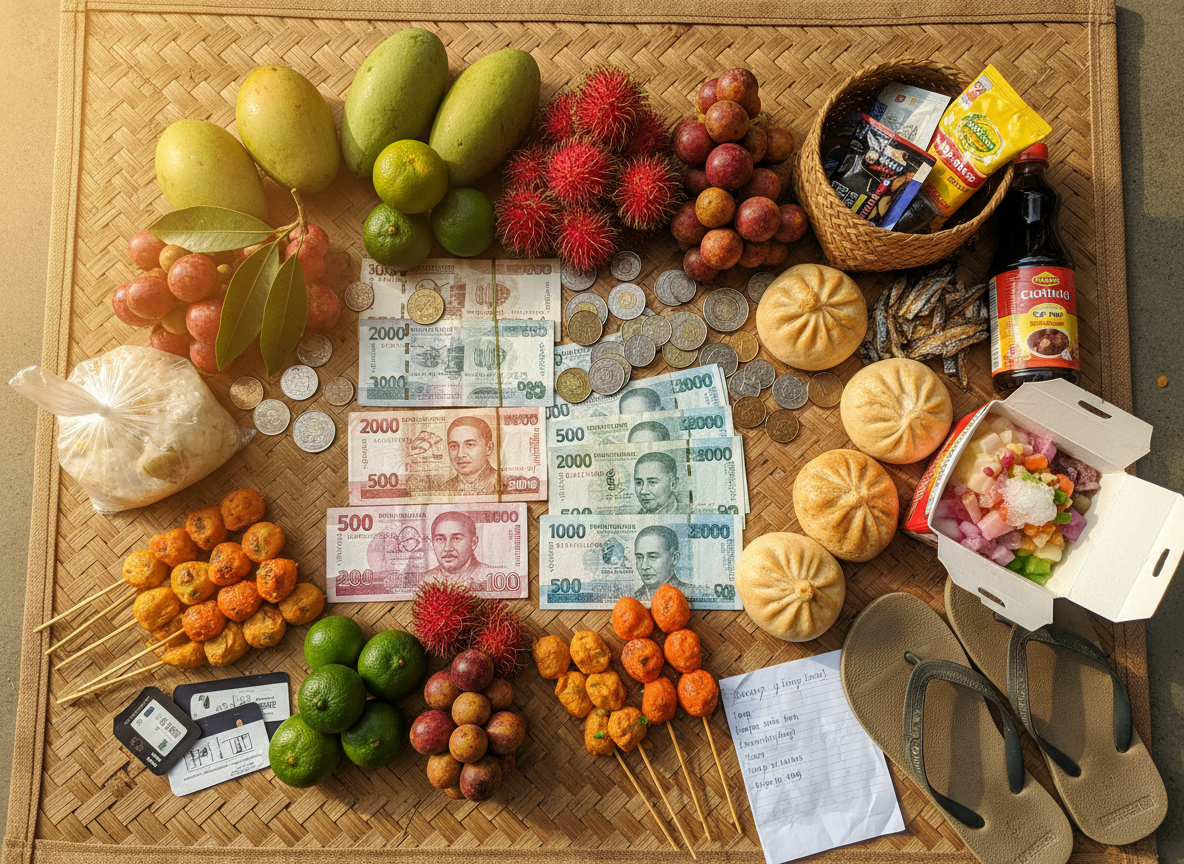
One of the biggest attractions of living or retiring in the Philippines is that your money can often go considerably further than it does in the United States, Canada, Australia, or many parts of Europe. But statements like “the Philippines is cheap” do not really tell you much about what everyday life actually costs.
A better question is much simpler: What can $100 actually buy you in the Philippines? At recent 2026 exchange rates, $100 is roughly equivalent to somewhere around ₱6,000 to ₱6,200, although currency values change every day. That amount will not pay for a luxury vacation or a month of living expenses, but depending on where and how you spend it, ₱6,000 can cover a surprising amount of everyday life.
The important thing to remember is that the Philippines is not one giant marketplace with identical prices. What you pay in Bonifacio Global City or Makati can be very different from what you pay in Dumaguete, Bacolod, Iloilo, or a provincial town. Imported food, tourist destinations, upscale restaurants, and premium condominiums can also quickly erase some of the savings.
Still, looking at what $100 can realistically buy provides a useful picture of the purchasing power foreign retirees and expats may experience.
First, How Much Is $100 in Philippine Pesos?
Exchange rates change constantly, so you should always check the current rate before transferring or exchanging money. For a simple illustration, however, we will use approximately ₱6,000 for $100 throughout this article.
That makes the math easy, and it provides a reasonable basis for understanding everyday prices. Your actual buying power will also depend on bank fees, ATM fees, currency-conversion charges, and where you exchange your money.
Scenario 1: $100 at the Grocery Store
Suppose you have approximately ₱6,000 and want to stock your refrigerator and pantry.
Current nationwide consumer-price estimates show examples such as a dozen eggs at roughly ₱120, a pound of chicken breast around ₱119, a pound of rice around ₱26, a liter of milk around ₱108, and a pound of bananas around ₱40. Prices vary considerably by store and city, but these figures give us a reasonable starting point.
A sample grocery cart might include:
- 2 dozen eggs
- Several pounds of chicken
- Several pounds of pork or beef
- Rice
- Fresh vegetables
- Bananas
- Mangoes or other seasonal fruit
- Bread
- Milk
- Coffee
- Cooking oil
- Pasta
- Canned goods
- Bottled or purified water
- Snacks
- Basic household supplies
If you primarily purchase Filipino brands, fresh produce, rice, meat, and locally available products, ₱6,000 can purchase a substantial amount of food for one person. A careful single retiree might stretch some of those groceries across a couple of weeks, although eating habits make an enormous difference.
If your shopping cart contains imported American cereal, premium cheese, imported steaks, foreign snacks, wine, and specialty products, the same ₱6,000 can disappear much faster. This is one of the most important lessons about cost of living in the Philippines: living locally and living cheaply are often connected.
Scenario 2: $100 Eating at Local Restaurants
Dining out can be one of the pleasures of living in the Philippines because you can choose from everything from simple neighborhood eateries to world-class restaurants.
Current nationwide estimates place an inexpensive restaurant meal at roughly ₱250. At that price, ₱6,000 theoretically represents about 24 inexpensive restaurant meals, although beverages, tips, transportation, and more expensive meals would naturally reduce that number.
You do not have to eat every meal at a traditional sit-down restaurant, either. A typical month might include inexpensive local restaurants, food courts, bakeries, barbecue stands, fast food, cafés, and the occasional nicer dinner.
For a retiree who enjoys going out for lunch, $100 can therefore represent many meals rather than one or two expensive evenings.
Scenario 3: Dinner for Two
Suppose instead of stretching your $100 across many small meals, you want to enjoy several nicer evenings out.
Current Philippine cost-of-living data estimates a three-course meal for two at a mid-range restaurant at around ₱1,270, without drinks. Using that estimate, ₱6,000 could cover roughly four such dinners for two, with some money left depending on where you eat.
Of course, a sophisticated restaurant in BGC, Makati, Cebu IT Park, or a luxury resort can cost considerably more. But in many cities, a couple can still enjoy a good restaurant meal without spending anything close to what a similar evening might cost in a major American city.
That can change retirement life in a small but meaningful way. Eating out may stop being something reserved only for birthdays and anniversaries and become part of your normal weekly routine.
Scenario 4: $100 for Transportation
Transportation is another area where $100 can stretch surprisingly far if you do not own a car.
Current nationwide estimates put a basic one-way local transportation fare at around ₱15, although actual jeepney, bus, train, tricycle, taxi, and ride-hailing fares depend on the route and city.
A retiree who walks frequently, uses public transportation, and occasionally takes Grab or a taxi may find that ₱6,000 covers a significant portion of a month’s transportation.
This is particularly important when deciding whether you need a car in the Philippines. A vehicle brings fuel, insurance, maintenance, parking, registration, and repair costs. For someone living in a walkable neighborhood with access to ride-hailing and public transportation, paying for rides only when needed can sometimes be the simpler option.
Scenario 5: $100 for Coffee, Lunch, and Everyday Treats
Not every retirement budget is about necessities. Part of the reason people move abroad is to enjoy life.
A regular cappuccino currently averages around ₱139 nationwide, while an inexpensive restaurant meal averages around ₱248. That means ₱6,000 could buy quite a few mornings at a café, lunches out, or combinations of the two.
Imagine spending several mornings each week at your favorite coffee shop, having lunch out occasionally, and stopping at a bakery on the way home. Those small experiences can become part of your normal routine instead of something you constantly calculate against a tight entertainment budget.
This is where purchasing power can affect quality of life more than the raw numbers suggest. Having an extra $100 does not simply mean buying more things; it can mean having more opportunities to get out of the house and enjoy your community.
Scenario 6: $100 for Entertainment
A movie ticket for an international release currently averages around ₱350 nationwide. At that price, ₱6,000 could theoretically purchase about 17 movie tickets, although snacks and transportation would obviously add to the cost.
You might instead use the money for a combination of activities. A weekend could include a movie, restaurant meal, coffee, local transportation, and perhaps a massage or another inexpensive activity, depending on your city.
The Philippines offers entertainment at almost every budget level. You can spend very little enjoying a public park, waterfront promenade, local fiesta, market, or beach, or you can spend much more at resorts, golf courses, casinos, luxury restaurants, or shopping centers.
Scenario 7: $100 Toward Your Internet and Mobile Phone
Reliable internet and mobile service are important for most foreign retirees, especially when staying connected with family overseas.
Current nationwide estimates put unlimited broadband internet of at least 60 Mbps at roughly ₱1,695 per month and a mobile plan with calls and 10GB or more of data at around ₱886. Actual plans vary by provider and location, but together those averages come to less than half of our ₱6,000 example budget.
That means $100 could potentially cover a month’s home internet and mobile service and still leave money available for other expenses.
For someone accustomed to paying much more for multiple communication services back home, this can be a noticeable difference in the monthly budget.
Scenario 8: $100 Toward Electricity
Here is an area where you should not automatically assume the Philippines is inexpensive.
Electricity is relatively costly, and 2026 has seen additional pressure on Philippine energy prices. Recent reporting has described Philippine residential electricity prices as among the highest in Southeast Asia, with rising imported-energy costs contributing to higher bills.
Current nationwide estimates place basic utilities for an approximately 915-square-foot apartment at more than ₱6,000 per month, although actual bills vary dramatically based on air-conditioning use, apartment size, location, appliances, and local utility rates.
So in this category, your $100 may disappear very quickly.
A retiree who runs multiple air conditioners day and night may be surprised by the monthly bill. Someone using inverter air conditioning selectively, ceiling fans, and good ventilation may spend substantially less.
This is an important reminder that not everything is cheaper in the Philippines.
Scenario 9: $100 at the Local Market
Now take the same ₱6,000 away from a modern supermarket and bring it to a local public market.
Your experience can be very different.
Markets commonly offer:
- Fresh fish
- Chicken and pork
- Rice
- Vegetables
- Bananas
- Mangoes
- Pineapples
- Eggs
- Herbs
- Spices
- Local snacks
- Prepared foods
Seasonal produce can offer particularly good value, and buying locally produced food generally avoids the premium associated with imported products.
You may also discover that shopping at a public market becomes more than an attempt to save money. Once you get comfortable with the environment and begin recognizing vendors, it can become part of your weekly routine and one of the better ways to connect with everyday Filipino life.
Scenario 10: $100 for a Weekend
Could $100 pay for a weekend getaway?
Sometimes, yes.
If you live near a destination that does not require airfare, ₱6,000 can potentially contribute toward transportation, a modest room, meals, and activities for a simple weekend. Exactly how far it goes depends heavily on the destination.
From Cebu, that might mean exploring somewhere on Cebu Island rather than flying elsewhere. From Manila, it could help fund a road trip to Tagaytay or another nearby destination. From Davao, it might cover part or much of a simple Samal Island weekend.
Luxury resorts can easily cost more than $100 per night, so this is not a claim that every Philippine vacation is inexpensive. The advantage is that residents often have access to small hotels, guesthouses, local transportation, and nearby destinations that international tourists may overlook.
When you live in the Philippines, you do not need every weekend to resemble a once-in-a-lifetime vacation.
Scenario 11: $100 Toward Rent
This is where location makes an enormous difference.
Current nationwide estimates put a one-bedroom apartment outside a city center at roughly ₱11,400 per month, while the national estimate for a one-bedroom apartment in a city center is closer to ₱19,700. Those averages include a huge range of locations, from inexpensive provincial cities to high-cost urban districts.
Using those broad averages, $100 would not pay your entire monthly rent in most established urban areas, but it could cover a meaningful portion of it.
In some smaller towns and provincial locations, inexpensive rentals can still be found at much lower prices than prime areas of Manila or Cebu. Conversely, a modern condominium in BGC, Makati, or another premium neighborhood can cost several times the national average.
This is why saying, “You can rent an apartment in the Philippines for $200,” without explaining where and what kind of apartment, is misleading.
What If You Spend $100 Like a Local?
This is where the experiment becomes interesting.
Suppose you begin with ₱6,000 and spend it primarily on local goods and services instead of imported products.
You might use it for:
- ₱2,500 in groceries from local markets and supermarkets
- ₱1,000 in casual restaurant meals
- ₱500 in local transportation
- ₱500 in coffee or snacks
- ₱500 toward mobile service
- ₱1,000 for entertainment or a weekend outing
The exact numbers are only illustrative, but the point is important. $100 can touch several different parts of everyday life when your spending habits match local prices.
Try the same experiment with imported food, luxury restaurants, premium shopping centers, and taxis everywhere, and the money disappears much faster.
What $100 Does NOT Mean
Articles about low-cost countries can sometimes create unrealistic expectations.
Living in the Philippines is not automatically cheap.
You can spend a tremendous amount of money here if you choose to.
A luxury condo can be expensive. International schools can be expensive. Imported groceries can be expensive. Electricity can be expensive. Frequent flights, resorts, nightlife, Western restaurants, and shopping can turn a supposedly inexpensive retirement into a costly one.
The Philippines gives you options.
That is a more accurate way to think about it.
You can create a relatively modest lifestyle using local products and services, or you can build a lifestyle that costs almost as much as the one you left.
Manila vs. Cebu vs. Dumaguete vs. Provincial Living
Where you live has an enormous effect on what your $100 can buy.
In premium areas of Metro Manila, particularly Makati or BGC, you may pay prices approaching those of other major international cities for certain restaurants, apartments, and services.
Cebu offers a broad range. IT Park and Cebu Business Park can be relatively expensive, while neighborhoods farther from the center may offer better value.
Dumaguete, Bacolod, Iloilo, and many smaller cities can often allow a retiree’s money to stretch further, especially with housing and local dining.
Provincial living may provide the lowest costs, but that affordability can come with trade-offs involving healthcare, transportation, shopping, entertainment, and access to international airports.
The cheapest location is not always the best retirement location.
The Real Secret Is Not the Exchange Rate
People often focus on converting dollars into pesos.
That matters, but it is not the entire story.
The bigger advantage comes from changing how you spend.
If you move to the Philippines but insist on recreating your exact American lifestyle, buy mostly imported brands, eat at upscale Western restaurants, live in a luxury condominium, and travel constantly, your savings may be much smaller than expected.
If you discover Filipino foods you enjoy, shop locally, use local services, choose housing carefully, and build your lifestyle around the community where you live, your money can go substantially further.
That does not mean living poorly.
It means living differently.
A $100 Challenge for New Expats
When you first arrive, try an experiment.
Withdraw approximately ₱6,000 and keep track of what it buys during an ordinary week. Do not deliberately live as cheaply as possible; simply spend normally while paying attention.
Record what you spend on:
- Food
- Transportation
- Coffee
- Groceries
- Entertainment
- Household items
At the end of the week, compare that experience with what the same $100 would have purchased in your home country.
You may be surprised.
More importantly, you will begin learning your real personal cost of living, which is far more valuable than any online estimate.
Final Thoughts
So, what does $100 buy you in the Philippines?
There is no single answer.
It could buy roughly two dozen inexpensive restaurant meals. It could stock a refrigerator with a significant amount of locally produced food. It could cover a month of internet and mobile service with money remaining. It could fund transportation, entertainment, and coffee for weeks, or contribute substantially toward a simple weekend trip.
It could also disappear during one evening at an upscale restaurant or cover only part of a large electricity bill.
That is the reality of living in the Philippines.
The country can be remarkably affordable, but the lifestyle you choose determines whether it actually is.
For retirees, that flexibility may be one of the Philippines’ greatest advantages. You do not necessarily have to live an austere life simply because you are watching your budget.
A morning coffee, lunch with friends, fresh food from the market, a ride across town, and the occasional weekend adventure can still fit into an ordinary retirement.
And sometimes understanding what $100 actually buys tells you more about life in the Philippines than any cost-of-living index ever could.
Five SEO Keywords
- What Does $100 Buy in the Philippines
- Cost of Living in the Philippines
- Philippines Prices for Expats
- How Far Does $100 Go in the Philippines
- Retiring in the Philippines on a Budget
Suggested SEO Title
What Does $100 Buy You in the Philippines? A Real-Life Spending Guide
Suggested Meta Description
How far does $100 go in the Philippines? See what it can buy in groceries, restaurants, transportation, internet, entertainment, rent, and weekend travel.
Suggested URL Slug
/what-does-100-dollars-buy-in-the-philippines
Leave a Reply