
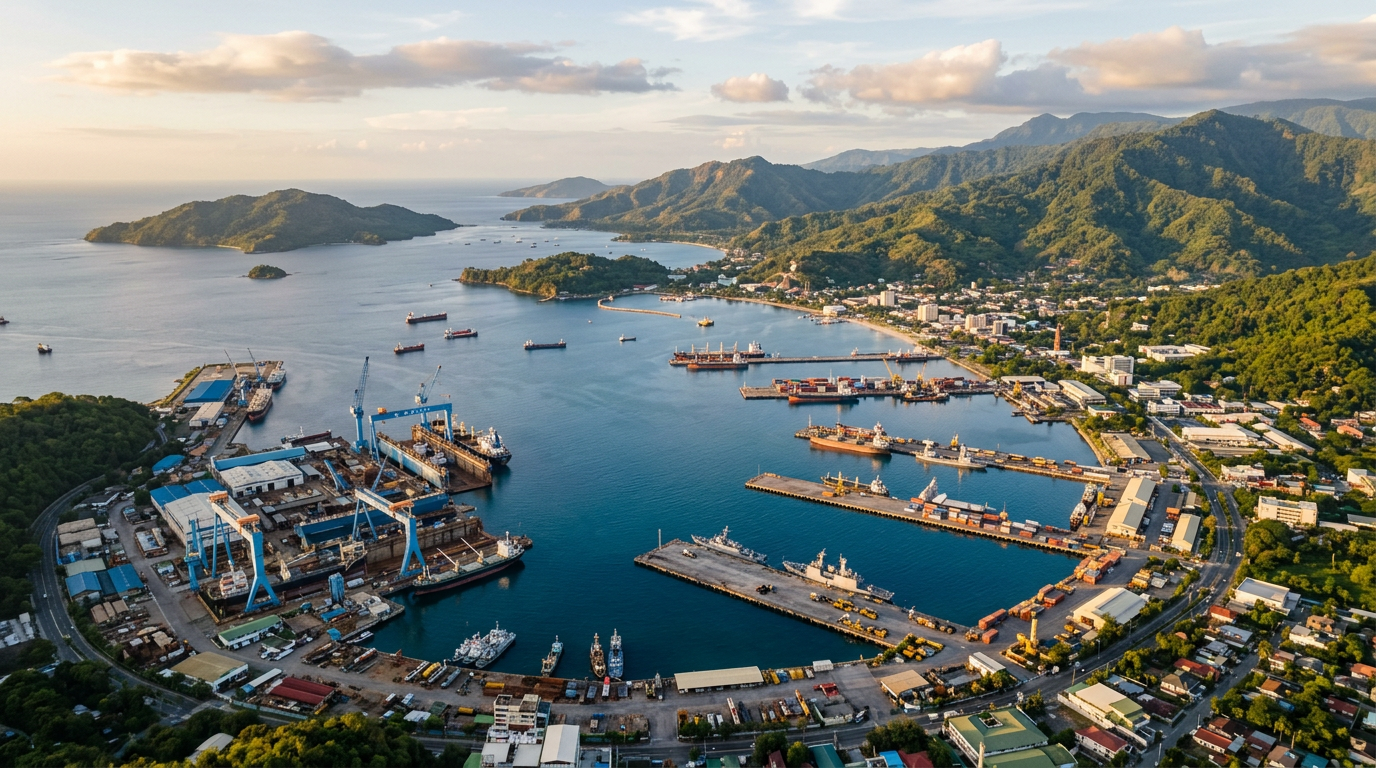
For anyone who remembers the Philippines during the Cold War, the name Subic Bay means something very different than it does to younger generations.
For decades, U.S. Naval Base Subic Bay was one of America’s most important military installations in the Pacific. American ships filled the harbor, thousands of military personnel passed through the area, and nearby Olongapo developed around one of the largest overseas U.S. naval facilities in the world.
Then it ended.
The U.S. military left Subic Bay in 1992 after the Philippine Senate rejected a treaty that would have extended the American military presence. The former base was transformed into the Subic Bay Freeport Zone, and over the following three decades Subic reinvented itself as a center for shipping, tourism, manufacturing, aviation, logistics, and residential development.
Now, more than three decades later, something remarkable is happening.
The U.S. military is returning to Subic Bay.
But it is important to understand exactly what that means.
The Philippines and United States have not announced that the old U.S. Naval Base Subic Bay is being reopened. Nor has Subic been formally designated as a new permanent joint U.S.-Philippine naval base.
Instead, something more gradual is taking place.
American military equipment is again moving through Subic. U.S. forces are using its airport and port facilities. Military equipment is being staged there for exercises and contingencies. The U.S. Marine Corps has established a prepositioning presence. The U.S. Navy has pursued additional storage and maintenance space. Philippine military organizations are also expanding their presence in the area.
At the same time, major American, Philippine, and South Korean commercial investment is rebuilding Subic’s shipbuilding and logistics capabilities.
In practical terms, Subic Bay is once again becoming an important hub in the U.S.-Philippine defense relationship.
And this could have consequences reaching far beyond the military.
For foreigners considering Subic, Clark, Angeles City, or Central Luzon as a place to live or retire, the changes could eventually affect jobs, infrastructure, transportation, housing, businesses, tourism, healthcare, and property demand.
It could also bring geopolitical risks.
Here is what is happening, how we got here, what may happen next, and what it could mean for people living in the area.
Why Subic Bay Matters So Much
Look at Subic Bay on a map and its importance becomes easier to understand.
It has a large natural deep-water harbor on the western side of Luzon with access toward the South China Sea. It is relatively close to Metro Manila and connected to Clark and the broader Central Luzon economic region.
It also has something that is difficult and expensive to reproduce:
existing infrastructure.
Subic already has port facilities, piers, an international airport, warehouses, roads, industrial areas, shipyard facilities, and a workforce accustomed to maritime and logistics industries.
That makes Subic valuable commercially.
It also makes it strategically valuable.
Instead of building an entirely new logistics complex from scratch, military planners can use or lease existing infrastructure while Philippine authorities continue developing the region for commercial purposes.
That combination is one reason Subic has again attracted so much attention.
1992: The Americans Leave
To understand why today’s developments are so significant, go back to 1991 and 1992.
The United States had maintained a major military presence in the Philippines for decades, including Naval Base Subic Bay and Clark Air Base.
In 1991, the Philippine Senate rejected a new bases treaty.
Mount Pinatubo had also erupted that year, severely damaging Clark and affecting the surrounding region.
Clark Air Base was turned over to the Philippines, and the American presence at Subic subsequently ended.
In November 1992, the U.S. Navy formally withdrew from Subic Bay.
For many people, that appeared to close the chapter on large-scale American military operations there.
But the U.S.-Philippine alliance itself never disappeared.
1992–2014: Subic Reinvents Itself
Instead of allowing the enormous former military installation to sit abandoned, the Philippines transformed the area into the Subic Bay Freeport Zone.
Commercial shipping expanded.
Businesses arrived.
Tourism developed.
Former military facilities found civilian uses.
Subic became known for its freeport, beaches, resorts, duty-free shopping, maritime industries, and relatively orderly residential communities.
The former base became an interesting example of military infrastructure being converted into an economic zone.
For more than two decades, Subic’s identity increasingly became commercial rather than military.
Then regional security began changing.
2014: The Enhanced Defense Cooperation Agreement Changes the Relationship
The United States and Philippines signed the Enhanced Defense Cooperation Agreement, commonly called EDCA, in 2014.
EDCA allows rotational U.S. military access to agreed Philippine military locations and permits facilities, equipment, and supplies to be positioned under the agreement.
This is an important distinction.
EDCA did not recreate permanent American military bases in the Philippines.
Philippine sovereignty over the locations remains intact.
But the agreement created a framework allowing much deeper military cooperation.
As tensions increased in the South China Sea, that framework became increasingly important.
2022: A Critical Piece of Subic Changes Hands
Another major development occurred at the former Hanjin shipyard.
After Hanjin Heavy Industries Philippines entered bankruptcy, there was concern about who might acquire the enormous shipbuilding complex.
In 2022, American investment firm Cerberus Capital Management acquired the roughly 300-hectare property for approximately $300 million.
The complex became known as Agila Subic.
That acquisition was significant because the facility includes major maritime infrastructure directly on Subic Bay.
It also prevented a strategically important shipyard from falling into Chinese ownership at a time when concerns about China’s activities in the South China Sea were increasing.
Subic was beginning to matter strategically again.
2023–2025: The Return Accelerates
The redevelopment of Agila Subic didn’t stop with an American investment company.
SubCom, an American subsea communications-cable company, established operations there.
Then South Korea’s HD Hyundai Heavy Industries entered the picture.
In September 2025, a newly revitalized shipyard operated by HD Hyundai Heavy Industries Philippines was inaugurated at Subic.
The goal is much larger than military activity.
The revived shipbuilding complex is expected to substantially increase Philippine shipbuilding capacity and could eventually employ thousands of Filipino workers.
That matters because Subic’s resurgence isn’t simply an American military story.
It is becoming a Philippine-American-South Korean industrial and strategic development story.
2025: The U.S. Marine Corps Establishes a Persistent Presence
One development was particularly symbolic.
In February 2025, the U.S. Marine Corps leased approximately 57,000 square feet of warehouse space at Subic for prepositioning purposes.
It represented one of the first persistent American military logistics footprints at Subic since the closure of the former naval base.
Again, this wasn’t the reopening of the old base.
But the symbolism was difficult to miss.
More than thirty years after American forces left, U.S. military supplies were once again being positioned at Subic.
2026: Subic Becomes a Major Military Logistics Gateway
This year has made the direction much clearer.
During preparations for Balikatan 2026, the large annual U.S.-Philippine military exercise, Subic served as an important logistics gateway.
The U.S. military used Subic Bay International Airport as an airport of debarkation and the Port of Agila as a seaport of debarkation.
American military equipment arriving in the Philippines could be received, staged, and moved onward from Subic.
Equipment and aircraft associated with U.S. military exercises have passed through the area.
That is a significant change from simply having an occasional American naval vessel make a port visit.
Subic is becoming part of the logistics system supporting U.S.-Philippine military operations.
April 2026: Equipment Is Staged at Agila Subic
During Balikatan preparations, U.S. Army equipment was staged at Agila Subic.
That included military vehicles and aircraft arriving through the port.
The U.S. military also contracted for armed security around sensitive equipment.
The significance isn’t simply that American equipment arrived.
Military planners demonstrated that Subic could function as a location where equipment is received, secured, staged, maintained, and moved onward to other parts of the Philippines.
That is exactly the type of capability that makes a logistics hub strategically valuable.
June 2026: Pacific Partnership Establishes a Subic Hub
Subic’s military role isn’t limited to combat exercises.
In June 2026, U.S. and Canadian military personnel established a mission coordination hub in Subic for Pacific Partnership 2026, the U.S. Navy’s major humanitarian assistance and disaster-preparedness mission in the Indo-Pacific.
Personnel specializing in medicine, engineering, disaster management, and outreach used Subic as a coordination location.
This highlights another reason Subic matters to the Philippines.
The same ports, airports, warehouses, communications systems, and logistics capabilities useful during a military contingency can also be valuable following earthquakes, typhoons, volcanic eruptions, and other disasters.
For a country that regularly experiences natural disasters, that capability has practical peacetime value.
August 2026: The Military Activity Is Still Growing
The trend has continued.
On August 17, U.S. Marines reportedly rehearsed deployment of a sophisticated Ground/Air Task Oriented Radar, or G/ATOR, through Subic Bay International Airport.
The radar can support aerial surveillance, air traffic control, counter-artillery operations, and air defense.
The important point isn’t one particular radar.
It’s that the former Cubi Point airfield is again functioning as a location from which advanced American military systems can enter the Philippines and potentially move elsewhere in the archipelago.
Subic is increasingly becoming a gateway, rather than simply a destination.
What Happens Next?
There is no single announced date when someone will cut a ribbon and declare:
“Subic Bay Naval Base has reopened.”
That is probably the wrong way to think about what is happening.
The return is occurring in stages.
Phase One: Already Happening
This phase is underway now.
American military equipment passes through Subic.
U.S. forces use Subic during exercises.
Equipment is staged at Agila Subic.
The Marine Corps has warehouse space.
The airport and port support military logistics.
U.S. and allied personnel use the area for military and humanitarian missions.
Meanwhile, commercial shipbuilding and industrial redevelopment are accelerating.
Phase Two: 2026–2027
This is likely to involve deeper logistics capabilities.
The U.S. Navy has pursued additional warehouse and maintenance space in the Subic Freeport area. Plans reported in 2025 envisioned operations beginning around September 2026.
The proposed facility would provide roughly 25,000 square meters of climate-controlled warehouse and maintenance space for vehicles and equipment.
Importantly, the proposal specified that munitions would not be stored there.
If completed and fully utilized, this would further shift Subic from an occasional exercise location toward a more persistent logistics network.
Phase Three: Infrastructure Expansion
Subic’s transformation is also connected to the larger Luzon Economic Corridor linking Subic, Clark, Manila, and Batangas.
Plans include improved transportation and freight connections between Subic and Clark.
The Philippines is also moving forward with modernization and expansion plans for Subic International Airport.
That project includes rehabilitation of deteriorated facilities and improvements intended to expand commercial aviation, cargo, logistics, and other operations.
This is important for residents because military investment isn’t occurring in isolation.
Subic is receiving attention as an economic and transportation hub too.
Phase Four: A Larger Philippine Military Presence
Another development to watch is the Philippine military itself.
The Philippine Navy, Marine Corps, Air Force, and Coast Guard have all been working toward expanded facilities or operations in the Subic area.
That means the long-term future may look less like the old American Subic Bay Naval Base and more like something new:
A Philippine-controlled strategic hub where Philippine forces, American forces, allied militaries, commercial shipbuilders, logistics companies, and civilian businesses operate alongside one another.
That could ultimately make Subic more important than simply recreating the base that existed before 1992.
Why Is This Happening?
One country dominates the strategic explanation.
China.
The Philippines and China remain in disputes over portions of the South China Sea.
Chinese and Philippine vessels have repeatedly confronted one another around disputed waters and features.
The United States and Philippines, meanwhile, are bound by their Mutual Defense Treaty.
The two countries have dramatically increased military exercises, interoperability, equipment deployments, and defense cooperation.
Subic sits in an extraordinarily useful location for those efforts.
It faces the South China Sea.
It has a deep-water harbor.
It has aviation facilities.
It has a massive shipyard.
It has road connections into Luzon.
And unlike building a completely new military logistics center, much of the basic infrastructure already exists.
What Could This Mean for Subic’s Economy?
This is where the story becomes especially relevant to Philippine Living Guide readers.
Military activity brings people.
People require housing.
They eat in restaurants.
They shop.
They need transportation.
Contractors need offices.
Companies need warehouses.
Ships need maintenance.
Facilities need construction.
Employees need housing.
Families need schools.
Businesses need workers.
That economic activity can spread beyond the actual military facilities.
Olongapo, Subic, Clark, Angeles City, and other parts of Central Luzon could potentially benefit from the broader investment.
But it is important not to exaggerate.
This does not mean tens of thousands of American sailors are suddenly going to move back into Subic like they did during the Cold War.
The modern American military strategy in the Philippines relies much more heavily on rotational deployments, joint exercises, logistics access, prepositioned equipment, and distributed facilities.
The economic impact will therefore probably look different from the pre-1992 era.
More Jobs Could Be One of the Biggest Effects
Shipbuilding alone could become significant.
The revived HD Hyundai operation is expected to eventually employ thousands of Filipinos as production expands.
Then add:
Construction.
Logistics.
Warehouse operations.
Security.
Transportation.
Aircraft services.
Ship maintenance.
Restaurants.
Hotels.
Property management.
Retail.
Professional services.
Technology.
Infrastructure.
The larger story may ultimately be that defense cooperation helps accelerate an economic redevelopment already underway.
Could Property Values and Rents Increase?
Possibly.
Whenever a region receives major infrastructure investment, industrial development, new employment, and an influx of workers, housing demand can increase.
Subic already appeals to some foreigners because of its combination of infrastructure, security, nature, proximity to beaches, and access to Clark.
Additional investment could make it more attractive.
But prospective retirees shouldn’t buy property based on the assumption that a military boom will automatically send prices soaring.
Infrastructure projects get delayed.
Military priorities change.
Political administrations change.
Real-estate markets fluctuate.
A better reason to live in Subic is because you actually want to live in Subic.
Any appreciation created by regional development should be considered a possible bonus rather than the reason for moving there.
Clark Could Benefit Too
This story isn’t limited to Subic.
Subic and Clark increasingly function as complementary economic centers.
Clark has the international airport, large-scale commercial development, industrial parks, modern residential communities, and proximity to Angeles City.
Subic has the deep-water port, shipyards, aviation facilities, and access to the South China Sea.
Connecting them more efficiently creates a powerful logistics corridor.
For an expat deciding between Subic and Clark, that could make the entire region increasingly attractive.
You could potentially live in a relatively quiet Subic community while retaining access to Clark International Airport and the expanding commercial services of Central Luzon.
Subic International Airport Could Become More Important
One development worth watching closely has nothing directly to do with American forces.
The Philippine government is moving forward with a public-private partnership to modernize, expand, operate, and maintain Subic International Airport.
The project entered the Comparative Challenge process in 2026.
The goal includes improving aviation infrastructure, cargo handling, logistics, and commercial aviation potential.
If Subic eventually develops more regular passenger service, that could have a meaningful impact on tourism and residential attractiveness.
For retirees, easier air connectivity can matter enormously.
An area becomes much more attractive when visiting family doesn’t require a difficult journey through Manila every time.
The Other Side of the Story: Security Risk
There is another side that shouldn’t be ignored.
The more strategically important Subic becomes to the Philippine and American militaries, the more strategically important it becomes to China.
In a major conflict involving the United States, Philippines, Taiwan, or the South China Sea, logistics hubs would have military significance.
That doesn’t mean people living in Subic should expect war.
It means increased military importance brings both economic benefits and geopolitical exposure.
Foreign retirees considering the region should understand both.
The Philippines itself has made the calculation that strengthening its defense capabilities and alliance relationships improves deterrence and therefore reduces the likelihood of aggression.
Critics can reasonably argue that hosting more American military activity could also make certain Philippine locations more prominent targets during a conflict.
Both considerations belong in the conversation.
Will Subic Become an American Base Again?
Probably not in the way people remember it.
The giant permanent overseas bases of the Cold War aren’t necessarily the model being rebuilt.
The emerging system is more distributed.
Philippine bases.
Commercial ports.
Airfields.
Warehouses.
Prepositioned equipment.
Rotational forces.
Joint exercises.
Temporary deployments.
Allied access.
Shared logistics.
Subic fits that strategy extremely well.
So rather than asking:
“When will the Americans reopen Subic Bay Naval Base?”
A better question may be:
“How much of the old base’s strategic function is returning without actually recreating the old base?”
The answer appears to be:
More every year.
A Timeline of Subic Bay’s Return
1991 — The Philippine Senate rejects a treaty that would have extended the American base presence.
1992 — U.S. forces leave Subic Bay and the former naval base is turned over to the Philippines.
1992 onward — The Subic Bay Metropolitan Authority develops the former base into the Subic Bay Freeport Zone.
2014 — The Philippines and United States sign EDCA, creating a framework for expanded rotational U.S. military access and cooperation.
2019 — Hanjin Heavy Industries Philippines’ financial collapse leaves the massive Subic shipyard’s future uncertain.
2022 — U.S.-based Cerberus Capital Management acquires the roughly 300-hectare shipyard and renames the complex Agila Subic.
2023 — American subsea-cable company SubCom begins operations at the complex.
2025 — The U.S. Marine Corps leases warehouse space at Subic for prepositioning.
September 2025 — HD Hyundai Heavy Industries Philippines inaugurates its revitalized shipyard operation at Subic.
Early 2026 — Subic becomes a major logistics gateway for Balikatan 2026.
April 2026 — U.S. military equipment is received and staged at Agila Subic.
June 2026 — Pacific Partnership 2026 establishes a mission coordination hub at Subic.
August 2026 — Advanced U.S. Marine Corps radar deployment training reportedly uses Subic Bay International Airport.
Late 2026 and beyond — Additional U.S. Navy logistics/storage activity, airport redevelopment, shipyard expansion, Philippine military development, and Luzon Economic Corridor projects are among the developments to watch.
What Should Expats Watch Over the Next Five Years?
For someone considering Subic or Clark as a retirement destination, I would watch five things.
Airport development. Regular commercial passenger service at a modernized Subic airport could significantly improve the area’s convenience.
Subic-Clark transportation. Better freight and passenger connections could increasingly integrate the two regions.
Healthcare. Population and economic growth could encourage additional private healthcare investment.
Housing costs. Increased employment and foreign activity could gradually place upward pressure on desirable residential areas.
Military activity. The scale and permanence of American and Philippine operations will determine how much the area’s character actually changes.
This isn’t going to happen overnight.
But five or ten years from now, Subic may look considerably different than it does today.
Could Subic Become One of the Philippines’ Most Interesting Retirement Locations?
Possibly.
Subic already has several qualities that appeal to foreign retirees.
It is relatively organized.
English is widely spoken.
There are established foreign residents.
Nature is nearby.
The bay is beautiful.
Clark International Airport is accessible.
Metro Manila is reachable without living in Metro Manila.
There are restaurants, shopping, resorts, recreational opportunities, and established residential communities.
Now add growing infrastructure investment, shipbuilding, logistics, airport redevelopment, and renewed strategic importance.
That combination makes Subic a place worth watching.
Not because American sailors are coming back.
But because investment is coming back.
Final Thoughts
The story of Subic Bay has come almost full circle.
For most of the twentieth century, it was one of America’s most important military installations in Asia.
In 1992, the Americans left.
The Philippines transformed the former base into a commercial freeport.
Three decades later, changing geopolitics have made Subic strategically important again.
But history isn’t simply repeating itself.
The Philippines isn’t handing Subic Bay back to the United States.
Instead, a new model is emerging.
Philippine sovereignty.
Commercial development.
American military access.
Philippine military expansion.
South Korean shipbuilding.
International logistics.
Infrastructure investment.
And increasingly close U.S.-Philippine defense cooperation.
For retirees and expats, the most important impact may ultimately have little to do with warships.
It may be better infrastructure, more jobs, improved transportation, new businesses, increased housing demand, and a stronger economic connection between Subic and Clark.
There are legitimate security questions that come with becoming strategically important again, and those shouldn’t be dismissed.
But there is also considerable economic potential.
Subic Bay spent more than thirty years transforming itself from a former American naval base into a Philippine economic zone.
Now it appears to be entering its next chapter:
not the reopening of the old Subic Bay Naval Base, but the emergence of a modern Philippine commercial, industrial, logistics, and defense hub shared with allies.
And this time, Subic’s future may be much bigger than simply being a military base.
Leave a Reply