
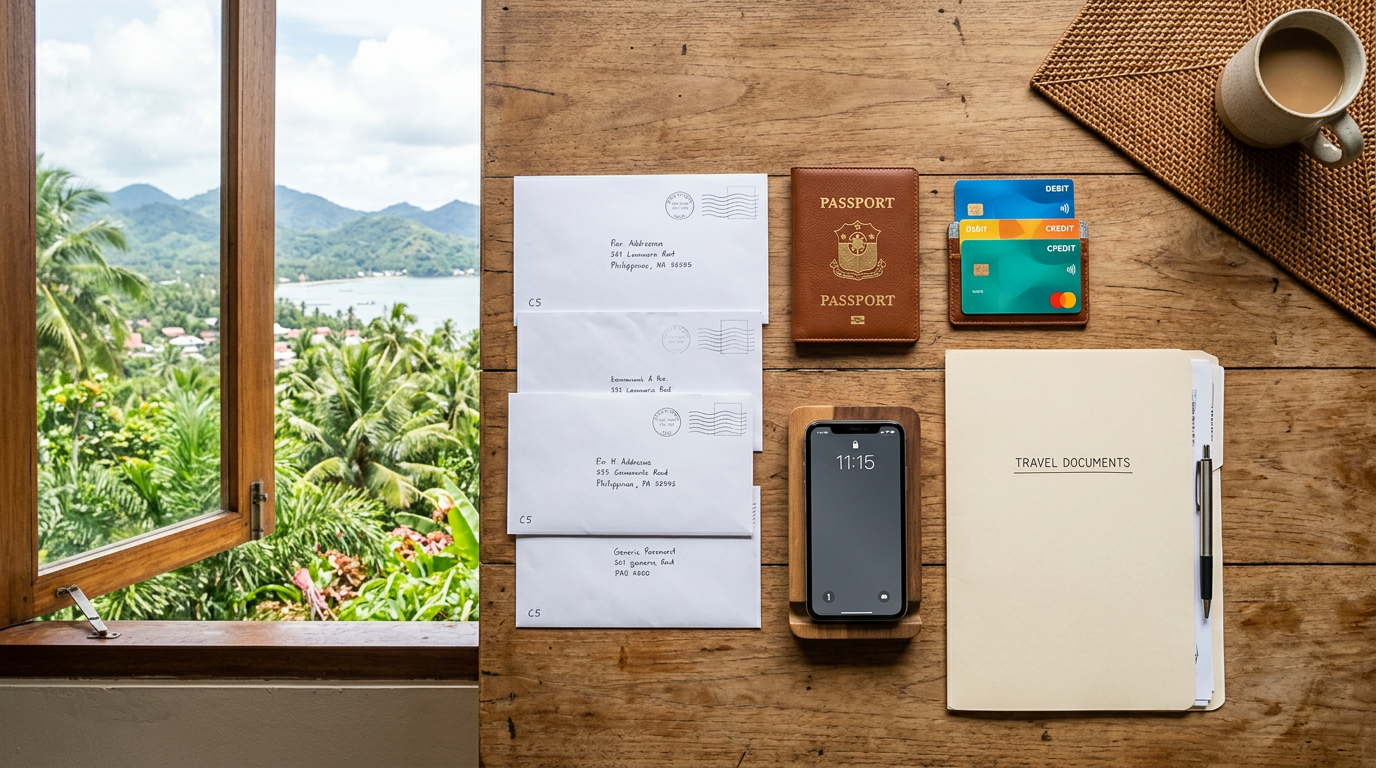
You’re moving to the Philippines.
The house is sold or the lease is ending. You’ve reduced your belongings, booked the flight and started thinking about everything you’ll need after you arrive.
Then you encounter a surprisingly complicated question:
What do you do with your U.S. address?
At first, the answer seems simple.
Use your brother’s house.
Use your daughter’s address.
Rent a mailbox.
Sign up for a virtual mail service.
But your address is connected to far more than your mail.
Banks use it.
Credit-card companies use it.
The IRS uses it.
Social Security uses it.
Your driver’s license uses it.
Insurance companies use it.
Investment accounts may use it.
Voter registration can involve it.
And different organizations don’t necessarily mean the same thing when they ask for your “address.”
For an American retiring in the Philippines, maintaining access to a U.S. mailing address can be extremely useful.
Pretending that mailing address is somewhere you actually live when it isn’t can create problems.
The trick is understanding the difference.
You May Actually Have Several Addresses
Before deciding what to do, understand that the word address can mean several different things.
A residential address generally means where you physically live.
A mailing address is where you want correspondence delivered.
A permanent address can have different meanings depending on who is asking.
And domicile is a legal concept generally associated with the place you consider your permanent legal home and intend to return to or maintain connections with.
Those aren’t automatically interchangeable.
You could physically live in Cebu, receive U.S. mail through a commercial mail-forwarding service in Florida, maintain financial accounts with a U.S. bank, and still have different rules determining your state tax residence or voting domicile.
That’s why the question isn’t simply:
Should I keep a U.S. address?
A better question is:
Which organizations need a mailing address, which need my actual residence, and which care about my legal domicile?
Yes, Keeping Access to U.S. Mail Is Usually a Good Idea
Even if you’re permanently moving to the Philippines, maintaining a dependable way to receive U.S. mail is extremely useful.
Government notices still arrive.
Banks occasionally mail replacement cards.
Tax documents arrive.
Insurance companies send correspondence.
Legal notices may arrive.
Some organizations still insist on sending verification codes or documents through regular mail.
And there will inevitably be something you forgot about until an envelope arrives six months after you’ve moved.
The solution doesn’t necessarily require maintaining a house or apartment in America.
What you really need is a reliable mail system.
Option One: Use a Trusted Family Member
This is probably the simplest solution.
You arrange to have certain mail delivered to a family member or trusted friend.
They can notify you when something important arrives, open and photograph it with your permission, or forward it to you.
For someone who receives very little physical mail, this may work perfectly.
But think about the long term.
Are you comfortable having that person receive financial or government correspondence?
Will they still be willing to do it five years from now?
What happens when a replacement credit card arrives?
Will they recognize an important tax notice rather than assuming it’s junk mail?
And most importantly, don’t automatically tell every organization that your relative’s home is your residence merely because they’re receiving your mail.
There’s a difference between:
“Send my mail here.”
and
“I live here.”
That distinction matters.
Option Two: Use a Virtual Mailbox
For many overseas retirees, this can be the cleaner solution.
A virtual mailbox or commercial mail-forwarding company gives you a U.S. mailing address.
Your mail arrives there.
You log into an app or website and see the envelopes.
Depending on the service, you can instruct the company to:
Open and scan it.
Forward it.
Hold it.
Shred it.
Or sometimes deposit a check.
This can be extremely convenient when you’re living 8,000 miles away.
Instead of paying international postage for every piece of mail, you only forward physical documents when you actually need them.
For someone planning to live overseas for years, this can be worth considering.
But Not Every “U.S. Address” Works Everywhere
This is where expats sometimes run into trouble.
A virtual mailbox may look like a normal street address.
That doesn’t necessarily mean every bank, government agency, insurance company or state DMV will accept it as proof that you live there.
Some organizations distinguish between residential addresses and commercial mail-receiving addresses.
Others may require proof of physical residence.
Financial institutions also have identity-verification and customer-information requirements that can make address questions more complicated than simply typing a U.S. address into a website.
Before choosing a mail service, ask what kind of address it provides and whether current customers commonly use it while living overseas.
More importantly, check the requirements of the institutions that matter to you.
Don’t assume one address will work for everything.
Your Bank May Be the Most Important Conversation
Before moving, talk to your banks, credit-card issuers and brokerage companies.
Don’t wait until you’re in the Philippines and suddenly discover that an account has been restricted.
Ask:
Do you allow customers who live permanently in the Philippines?
Then ask:
What address do you require from customers living overseas?
Those are much better questions than simply asking whether you can keep your account.
Policies vary.
Some institutions are comfortable serving American customers living overseas.
Others impose restrictions.
Brokerage accounts can be particularly complicated because financial firms may have rules about which services or investments they can provide to customers residing in foreign countries.
You may be allowed to keep an account but face restrictions on certain transactions.
Find this out before you move your entire financial life overseas.
Keep More Than One Way to Access Money
Address planning is part of a larger financial-security issue.
If you’re retiring in the Philippines, consider maintaining more than one way to access money.
For example, you might maintain a primary U.S. checking account plus another account or card as backup.
Why?
Cards get lost.
Fraud alerts happen.
ATMs keep cards.
Accounts occasionally get locked.
Banks replace debit cards.
International transactions can trigger security systems.
If your only debit card stops working on Friday night in Cebu, that’s a very different inconvenience than having a second account available.
Redundancy is useful when living overseas.
What About Social Security?
If you’re receiving Social Security and move overseas, don’t assume you need to pretend you’re still living in America.
The Social Security Administration specifically handles beneficiaries living abroad.
SSA instructs beneficiaries moving outside the United States to report their change of home address even if their benefits are deposited directly into a bank account.
U.S. citizens receiving Social Security benefits can also update an international address through their personal my Social Security account in certain circumstances.
Social Security also maintains international operations for people living overseas.
In other words, living in the Philippines doesn’t require maintaining the fiction that you’re still living at your old U.S. address.
Tell Social Security where you actually live and follow its current procedures for beneficiaries overseas.
Social Security Can Still Be Deposited Into a U.S. Bank
Where you live and where your money is deposited are separate issues.
Moving to the Philippines doesn’t automatically mean you have to close your U.S. bank accounts.
Many American retirees living overseas continue using U.S. accounts and then access money internationally through ATMs, transfers or other services.
Social Security also has systems for international beneficiaries and direct deposit.
The important thing is to arrange this before moving, while you still have easy access to your existing U.S. phone number, address, bank branches and identity documents.
Medicare Is Different Again
A U.S. mailing address doesn’t make healthcare received in the Philippines Medicare-covered.
Original Medicare generally doesn’t cover healthcare received outside the United States except in limited circumstances.
For Medicare purposes, however, “the United States” includes the 50 states, District of Columbia, Puerto Rico, U.S. Virgin Islands, Guam, Northern Mariana Islands and American Samoa.
That’s why we’ve discussed Guam and Saipan separately in Philippine Living Guide.
But maintaining a U.S. address doesn’t change where you actually received medical care.
If you receive treatment in Cebu, Manila or Dumaguete, using an American mailing address doesn’t transform that care into U.S.-based Medicare treatment.
Keep the address question and the coverage question separate.
What About the IRS?
Moving overseas doesn’t end your relationship with the IRS.
U.S. citizens generally remain subject to U.S. federal tax filing rules even when living abroad, depending on their individual circumstances.
The IRS has procedures for changing your address.
You can report a new address on your tax return, submit Form 8822 for an individual address change, or use other IRS-approved methods.
Don’t rely solely on postal forwarding.
If the IRS needs your current address, update it properly.
A virtual mailbox may still be useful for receiving correspondence, but tax residency, foreign income reporting and state domicile are separate issues that may require professional advice.
State Taxes Are Where Things Can Get Complicated
Federal taxes are only part of the picture.
Your former state may have its own rules for determining whether you’re still considered a resident.
This is where domicile becomes important.
States can consider factors such as where you maintain a home, driver’s license, voter registration, vehicle registration, financial relationships and other connections.
Simply announcing that you’ve moved overseas doesn’t necessarily resolve every state-tax question.
Likewise, keeping a mailing address in a state doesn’t necessarily mean you’re legally domiciled there.
The rules vary considerably.
If you’re leaving a state with an income tax or complicated residency rules, consider speaking with a tax professional familiar with Americans moving overseas.
A little planning before departure can prevent a much more expensive argument later.
Don’t Assume You Can Keep Your Driver’s License Forever
This is another common misunderstanding.
A driver’s license isn’t simply a convenient American identification card.
It’s issued based on state law.
For example, Pennsylvania generally prohibits PennDOT from issuing or renewing driver’s licenses to people who aren’t Pennsylvania residents, subject to specific exemptions.
Pennsylvania also requires a residence address and doesn’t allow a post-office box to serve as the only address on a driver’s license.
Other states have their own rules.
So don’t assume that forwarding your mail to your cousin’s house automatically entitles you to maintain a driver’s license showing your cousin’s address.
Before moving, check the rules of the state that issued your license.
Your Passport Becomes Even More Important
Once you’re living overseas, your U.S. passport becomes your primary American identity and travel document.
Keep it secure.
Know its expiration date.
Keep digital copies of the identification page somewhere secure.
Consider keeping a paper copy separate from the original.
And don’t wait until the last minute to renew it.
Losing a driver’s license is inconvenient.
Having a passport problem while living overseas can become considerably more complicated.
What About Voting?
Americans living overseas can still have federal voting rights.
The Federal Voting Assistance Program provides information for U.S. citizens living abroad, including people who no longer maintain a U.S. residence.
Voting residence is generally connected to the last U.S. address where you were domiciled before leaving the country, although specific circumstances and state rules matter.
This is another example of why “address” doesn’t have one universal definition.
Your overseas residence, mailing address and voting residence may not be identical.
Use the official overseas-voting process rather than inventing a residential address simply to remain registered.
Keep a U.S. Phone Number Too
This isn’t technically an address issue, but it belongs in the same conversation.
A U.S. phone number can be extremely useful after moving overseas.
Banks use text-message verification.
Credit-card companies use it.
Government websites use multi-factor authentication.
Online accounts use it for password recovery.
Before canceling your American mobile plan, investigate whether you can maintain your number inexpensively or transfer it to a service that works reliably from overseas.
But test it.
Not every internet-based phone service receives every bank’s security messages.
The cheapest solution isn’t useful if you can’t log into your bank.
Go Paperless Before You Leave
One of the easiest ways to solve the mail problem is to receive less mail.
Before leaving the United States, switch as much as possible to electronic delivery.
Bank statements.
Credit-card statements.
Investment statements.
Insurance documents.
Utility bills.
Tax documents where available.
Social Security notices where available.
Create a dedicated folder in your email for important financial correspondence.
Download important records rather than assuming you’ll always be able to access them online.
The less paper entering your U.S. mailbox, the easier overseas life becomes.
Build a Digital Document Vault
Before moving, scan the documents you might need later.
Passport.
Birth certificate.
Social Security information.
Driver’s license.
Insurance policies.
Bank information.
Tax records.
Property records.
Estate documents.
Medical information.
Important contact information.
Don’t simply store everything unprotected on your laptop.
Use secure, encrypted storage and maintain a backup.
Also decide who could access critical information if you were hospitalized or unable to manage your affairs.
This becomes particularly important for people retiring overseas alone.
Don’t Forget Your Credit Cards
Before moving, review your credit cards.
Which ones charge foreign transaction fees?
Which provide good international fraud protection?
Which allow replacement cards to be sent internationally?
Which require a U.S. residential address?
Which cards are connected to recurring payments?
It’s also wise to avoid carrying every card you own in your wallet.
Keep at least one backup card somewhere secure.
If your wallet disappears, you don’t want every method of payment disappearing with it.
What About USPS Mail Forwarding?
USPS forwarding can be useful during the transition.
But don’t treat it as your permanent overseas mail strategy.
Not everything is forwarded indefinitely.
Some mail isn’t forwarded.
Government agencies may have separate address requirements.
And eventually forwarding periods expire.
Use postal forwarding as a bridge while you individually update important organizations.
The goal should be to know exactly where important correspondence is going.
Make an Address List Before Moving
Several months before departure, start keeping track of everyone who has your address.
Every time mail arrives, ask:
Will this organization need my new information?
You’ll gradually build a list.
Banks.
Credit cards.
Brokerages.
IRS.
Social Security.
Medicare.
Insurance.
Former employer.
Retirement accounts.
Amazon and online retailers.
Professional organizations.
Subscriptions.
Friends and family.
You’ll probably discover organizations you’d completely forgotten about.
That’s much easier to fix while you’re still in America.
Should You Establish Residency in Another State First?
You’ll sometimes hear expats recommend establishing domicile in states such as Florida, South Dakota or Texas before moving overseas.
There can be legitimate reasons some full-time travelers and expatriates choose to do this.
But don’t do it simply because a YouTube video says you can rent a mailbox and magically become a resident.
State domicile involves legal and tax questions.
Requirements differ.
Your individual circumstances matter.
If changing domicile could materially affect your taxes, estate planning, driver’s license, insurance or voting rights, get professional advice before doing it.
A mailbox is a mail service.
It isn’t automatically a legal residence.
So, Should You Keep a U.S. Address?
For most American retirees moving to the Philippines, I’d frame the answer this way:
Keep reliable access to U.S. mail.
That could mean a trusted family member or a reputable virtual-mail service.
But don’t assume that mailing address can automatically substitute for your actual Philippine residence everywhere.
Tell organizations the truth about where you live when they’re asking for your residence.
Give them a separate U.S. mailing address when their rules allow one.
And understand which institutions have special requirements before you move.
The goal isn’t to create the appearance that you never left America.
The goal is to keep your American financial and administrative life functioning smoothly while you actually live in the Philippines.
The PLG Two-Address Strategy
A useful way to think about this is to maintain two pieces of information:
Where I live: Your actual Philippine residence.
Where I receive U.S. mail: Your chosen U.S. mail-forwarding service or trusted person’s address.
Sometimes an organization will accept both.
Sometimes it will only need one.
Sometimes its rules will require something different.
Ask.
Don’t guess.
That single habit can prevent a surprising number of problems.
Do This Before You Board the Plane
Don’t wait until you’re sitting in your new condo in Cebu to discover that your bank wants information you left in a filing cabinet in Pennsylvania.
Several months before moving, begin transitioning your administrative life.
Choose your mail solution.
Go paperless.
Talk to your banks.
Talk to your brokerage.
Update your important accounts.
Set up backup banking.
Preserve a reliable U.S. phone number.
Create online government accounts.
Scan important documents.
Check your driver’s-license situation.
Understand your tax and domicile situation.
And make sure someone you trust knows how to help if something happens to you.
Moving to the Philippines isn’t just about changing where you sleep.
You’re moving one life while maintaining connections to another.
The smoother you make that bridge before departure, the less time you’ll spend trying to fix it from the other side of the Pacific.
Philippine Living Guide Reminder
You don’t necessarily need to maintain a U.S. residence after moving to the Philippines.
But maintaining reliable U.S. mail access, banking access, digital access and emergency financial backup can make overseas retirement considerably easier.
Know the difference.
Disclaimer
Philippine Living Guide provides general educational and informational content for Americans considering travel, relocation or retirement in the Philippines. Address requirements can vary among banks, financial institutions, government agencies and states, and policies can change. This article isn’t legal, tax, financial, insurance or immigration advice. Before changing domicile, tax residency, banking information, insurance coverage or government records, verify current requirements with the appropriate institution or a qualified professional.
Leave a Reply