
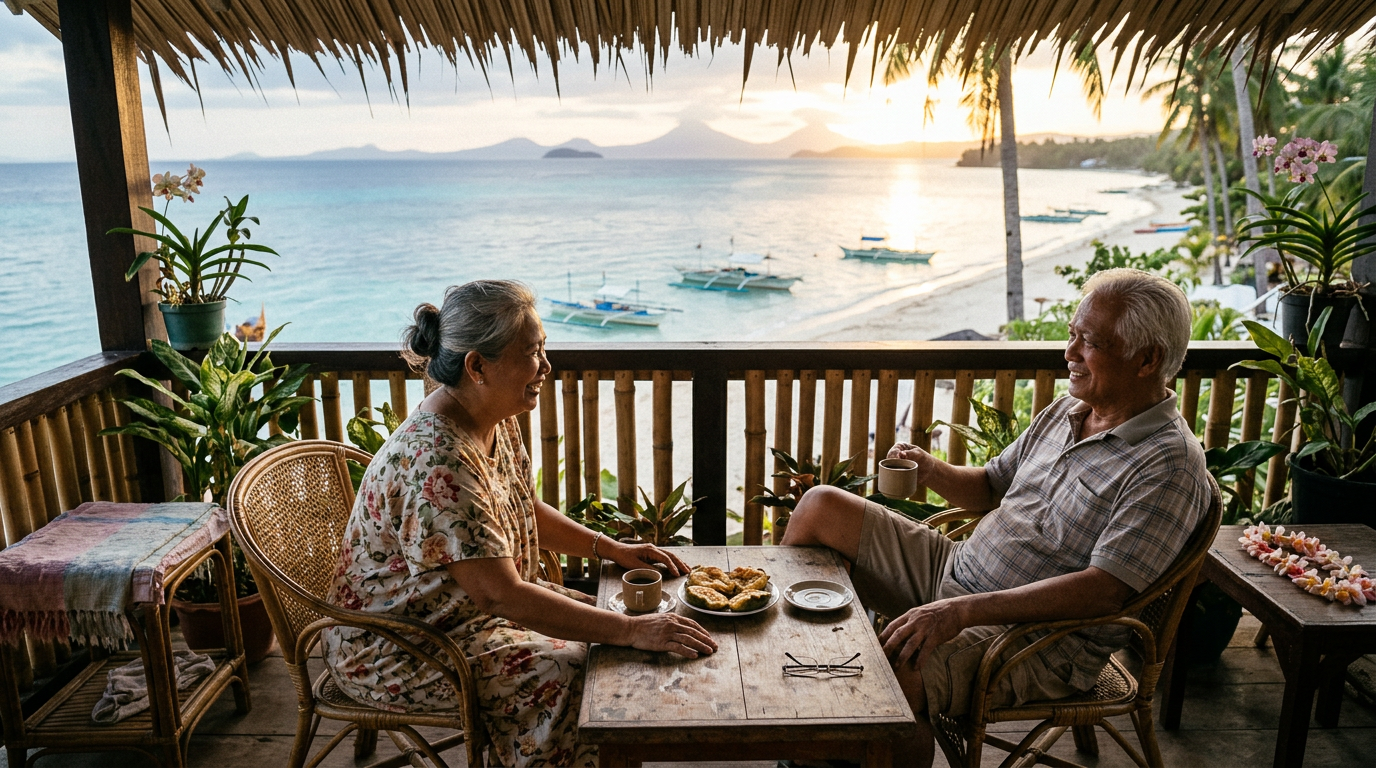
When people talk about retiring in the Philippines, one subject seems to dominate the conversation.
Money.
How cheaply can you rent an apartment?
How much does dinner cost?
Can you live on $1,500 a month?
How far will your Social Security go?
Those are legitimate questions, especially for someone trying to make retirement work on a limited income.
But what if you’re asking the wrong question?
What if the real attraction of retiring in the Philippines isn’t how little you can spend?
What if it’s how much life you can get from the money you already have?
That’s a very different way to look at retirement.
Retirement Doesn’t Have to Be About Cutting Back
For decades, the traditional picture of retirement has involved downsizing.
Smaller house.
Smaller budget.
Fewer expenses.
Watch your savings.
Stretch your retirement accounts.
Be careful about eating out.
Travel occasionally if the budget permits.
There’s nothing wrong with being financially responsible. But after spending 40 or 45 years working, retirement doesn’t necessarily have to become an exercise in figuring out how little you can spend.
Moving to the Philippines can potentially change that equation.
Instead of asking:
“How cheaply can I live?”
Ask:
“What kind of life can I afford?”
That may be the more interesting question.
Your Retirement Dollar Can Buy Something More Valuable Than Things
A lower cost of living is usually discussed in terms of prices.
Rent costs less.
Restaurant meals can cost less.
Services can cost less.
But the real benefit isn’t necessarily saving the difference.
It’s what you can do with the difference.
Suppose your retirement budget allows you to spend $3,000 or $4,000 a month comfortably.
You don’t have to reduce your lifestyle to $1,500 simply because someone on YouTube says you can.
Maybe you rent a nicer condominium.
Maybe you eat out several times a week.
Maybe you have someone clean your home.
Maybe you take a weekend trip every month.
Maybe you join a golf club.
Maybe you fly to Thailand for a week.
Maybe you finally learn to scuba dive.
The objective isn’t to die with the largest possible bank balance.
It’s to build a retirement you enjoy without jeopardizing your financial security.
You May Be Able to Buy Back Your Time
This is one of the most overlooked advantages of living somewhere with lower service costs.
Think about how much of your working life was spent doing things you didn’t particularly enjoy.
Cleaning the house.
Cutting grass.
Maintaining property.
Running errands.
Driving everywhere.
Doing laundry.
Cooking because eating out was too expensive.
Retirement gives you more time.
Living in the Philippines may allow you to protect more of it.
Household help is more accessible to many middle-income retirees than it would be in the United States, Canada, Australia, or much of Europe. Current retirement guides continue to identify affordable household assistance as one of the lifestyle advantages foreigners encounter in the Philippines.
That doesn’t mean you need servants waiting on you.
It means you may decide that paying someone fairly to clean once or twice a week is worth it.
You spent decades working for your time.
Retirement is when that time becomes valuable.
Eating Out Doesn’t Have to Be a Special Occasion
Another small lifestyle change can become surprisingly important.
For many retirees in expensive countries, eating out regularly can destroy a monthly budget.
In the Philippines, you have choices ranging from inexpensive Filipino restaurants and neighborhood eateries to international restaurants and high-end dining.
You don’t need to eat every meal out.
But having lunch with a friend doesn’t necessarily need to become a financial decision.
Neither does grabbing coffee.
Or deciding you don’t feel like cooking tonight.
Those little freedoms contribute to quality of life.
Retirement isn’t made up primarily of once-a-year vacations.
It’s made up of ordinary Wednesdays.
You Can Choose the Lifestyle That Fits You
One of the advantages of the Philippines is that there isn’t one Philippine retirement lifestyle.
You could live in a modern condominium in BGC surrounded by restaurants, shopping, nightlife, and some of the country’s best medical facilities.
You could choose Cebu and combine major-city conveniences with easier access to beaches and islands.
You could live in Dumaguete and enjoy a smaller university city with a significant foreign-retiree community. Nearly 400 Special Resident Retiree’s Visa holders were living in Dumaguete as of early 2026, with hundreds more spread across nearby Negros Oriental communities.
You could choose Iloilo for a growing modern city.
Baguio for cooler weather.
Clark for infrastructure and access to Luzon.
Bacolod for a slower pace.
Bohol if being closer to the water matters more than having every big-city convenience.
The question isn’t simply:
Where is cheapest?
It’s:
Where would I enjoy waking up every morning?
The Philippines Can Become Your Base for Seeing Asia
This may be one of the biggest lifestyle advantages for someone who spent most of their life in North America.
Look at where the Philippines sits on the map.
Japan.
South Korea.
Taiwan.
Hong Kong.
Vietnam.
Thailand.
Malaysia.
Singapore.
Indonesia.
All suddenly become much more accessible than they were when you lived on the other side of the Pacific.
And you don’t have to leave the Philippines to travel.
Cebu.
Palawan.
Boracay.
Bohol.
Siargao.
Dumaguete.
Camiguin.
Baguio.
Iloilo.
Bacolod.
Davao.
Hundreds of smaller islands and destinations.
The Philippine Retirement Authority has specifically noted that foreign retirees don’t simply settle in one location; once established, they travel throughout the country. As of June 2026, more than 86,000 foreign retirees from over 150 countries had made the Philippines their second home, according to recent government-reported figures.
Your retirement home can become your travel base.
That’s very different from saving all year for one annual vacation.
You Finally Have Time to Travel Slowly
This may be even better.
Working people travel differently.
Seven vacation days.
Fly Saturday.
See everything.
Rush everywhere.
Fly home Sunday.
Go back to work Monday exhausted.
Retirement changes the rules.
Want to spend ten days in Bohol?
You can.
Want to spend a month in Thailand?
Why not?
See a cheap flight to Japan next month?
Your calendar may actually be open.
Want to take the ferry somewhere and decide how long to stay after you arrive?
You can do that too.
You don’t have to travel like a tourist trying to maximize vacation days anymore.
You have something more valuable.
Time.
Warm Weather Changes Everyday Life
This is easy to underestimate when you’re planning from somewhere cold.
You don’t need to spend four or five months waiting for winter to end.
There isn’t snow to shovel.
There aren’t icy roads.
You don’t have to scrape the windshield before going to breakfast.
A tropical climate has its own challenges—heat, humidity, heavy rain, and typhoons depending on location—but it also makes outdoor life possible throughout the year.
Morning walks.
Swimming.
Outdoor cafés.
Golf.
Gardening.
Beach trips.
Sitting outside with coffee.
When you are retired, weather isn’t simply something you experience going to and from work.
It becomes part of your lifestyle.
English Makes the Transition Easier
This is one of the Philippines’ greatest advantages over many other Asian retirement destinations.
English is an official language and is widely used.
That doesn’t mean you’ll never encounter communication difficulties, and learning some Filipino or the language spoken in your particular region is worthwhile.
But consider the important situations.
Talking with a doctor.
Opening an account.
Speaking with your landlord.
Ordering dinner.
Shopping.
Asking directions.
Having a conversation with your neighbor.
Handling an emergency.
Being able to communicate in English removes a significant barrier for many foreigners. Current retirement guides continue to identify widespread English use as one of the country’s major advantages for Western retirees.
That can make the Philippines feel accessible much faster than places where you’re beginning with a substantial language barrier.
Your Social Life Doesn’t Have to Shrink After Retirement
Retirement can create an unexpected problem.
Work disappears.
And with it, many of the people you interacted with every day.
Your children have their own lives.
Friends may still be working.
People move.
Relationships change.
Suddenly you have plenty of free time but fewer people to spend it with.
Moving overseas forces you to rebuild.
That sounds intimidating, but it can also be invigorating.
You meet people you never would have met otherwise.
Filipinos.
Americans.
Australians.
Canadians.
Britons.
Europeans.
Other Asians.
People who retired.
People who started businesses.
People married to Filipinos.
People who simply decided they wanted a different life.
The Philippines scored strongly for expat community and integration in the 2026 Retirement Abroad Index, one of the factors contributing to its No. 1 ranking.
Your world can actually become bigger after retirement rather than smaller.
You Can Try Things You Never Had Time For
What did you always say you would do “someday”?
Learn photography?
Write a book?
Learn to cook Filipino food?
Take up diving?
Golf more?
Fish?
Start a website?
Learn another language?
Volunteer?
Get in better shape?
Travel?
Start painting?
Retirement isn’t simply the absence of work.
Ideally, it’s the presence of something else.
Moving to another country can give you permission to reinvent your routine because everything is changing anyway.
You’re already starting over.
Why not decide what you want the new version of your life to include?
You Don’t Have to Live Like You’re Rich
This is an important distinction.
Living better doesn’t mean pretending you’re wealthy.
It doesn’t mean renting a penthouse, hiring a driver, eating steak every night, and flying business class everywhere.
It means having choices.
Maybe your luxury is a two-bedroom apartment instead of a studio.
Maybe it’s having someone clean your home once a week.
Maybe it’s dinner out whenever you feel like it.
Maybe it’s a weekend in Bohol every few months.
Maybe it’s living five minutes from the ocean.
Maybe it’s never setting an alarm clock again.
Everyone defines a good life differently.
The advantage of lower living costs isn’t that you must spend less.
It’s that the same retirement income can potentially give you more choices.
Don’t Move Just Because It’s Cheap
This may sound strange in an article about living better for less, but it’s important.
If you don’t like the Philippines, cheap rent won’t make you happy.
If you hate tropical weather, a $400 apartment won’t fix that.
If you don’t enjoy Filipino culture, living inexpensively won’t change it.
If you need everything to operate exactly as it did in your home country, moving overseas may frustrate you.
Affordability should be one reason to consider the Philippines.
It shouldn’t be the only reason.
Come because you enjoy the country.
Come because you like the people.
Come because the lifestyle appeals to you.
Come because you want to explore Asia.
Come because you’re ready for something different.
Then let affordability make that life easier.
Why Are So Many Retirees Looking at the Philippines?
There’s evidence that the attraction is growing.
The Philippines was named the world’s No. 1 retirement destination in the Retirement Abroad Index 2026. The index evaluated 20 countries using healthcare quality, visa accessibility, health-insurance requirements, cost of living, and expat community and integration.
But rankings aren’t the reason to move somewhere.
They simply tell us other people are asking the same questions.
Can I afford it?
Can I get healthcare?
Can I stay legally?
Can I make friends?
Can I build a comfortable life?
Ultimately, you have to answer the final question yourself.
Ask a Different Retirement Question
Instead of asking:
“How little money do I need to retire in the Philippines?”
Try asking:
“If I have the retirement income I’ve already planned for, what kind of life could I build in the Philippines?”
That’s a much more exciting conversation.
Maybe the answer is a comfortable condominium, restaurant meals, a housekeeper, weekend trips, and two international vacations a year.
Maybe it’s a simple house near the water, a motorcycle, a dog, and absolutely no interest in luxury.
Maybe it’s six months in the Philippines and six months somewhere else.
Maybe it’s something you haven’t considered yet.
That’s the point.
You have choices.
Final Thoughts
For some people, retiring in the Philippines will absolutely be about making limited retirement income stretch further.
There’s nothing wrong with that.
But that’s not the only reason to consider moving.
You may already have enough money to retire comfortably in your home country.
The Philippines can still be attractive because retirement isn’t simply a financial calculation.
It’s about what happens after Monday morning no longer means going to work.
Where do you want to wake up?
What do you want to do today?
Who do you want around you?
What places do you still want to see?
What experiences have you been postponing?
And what do you want the next twenty or thirty years to look like?
After decades of asking whether you can afford to stop working, perhaps retirement is finally the time to ask a different question:
How well do I want to live?
The Philippines may give you an interesting answer.
Leave a Reply