
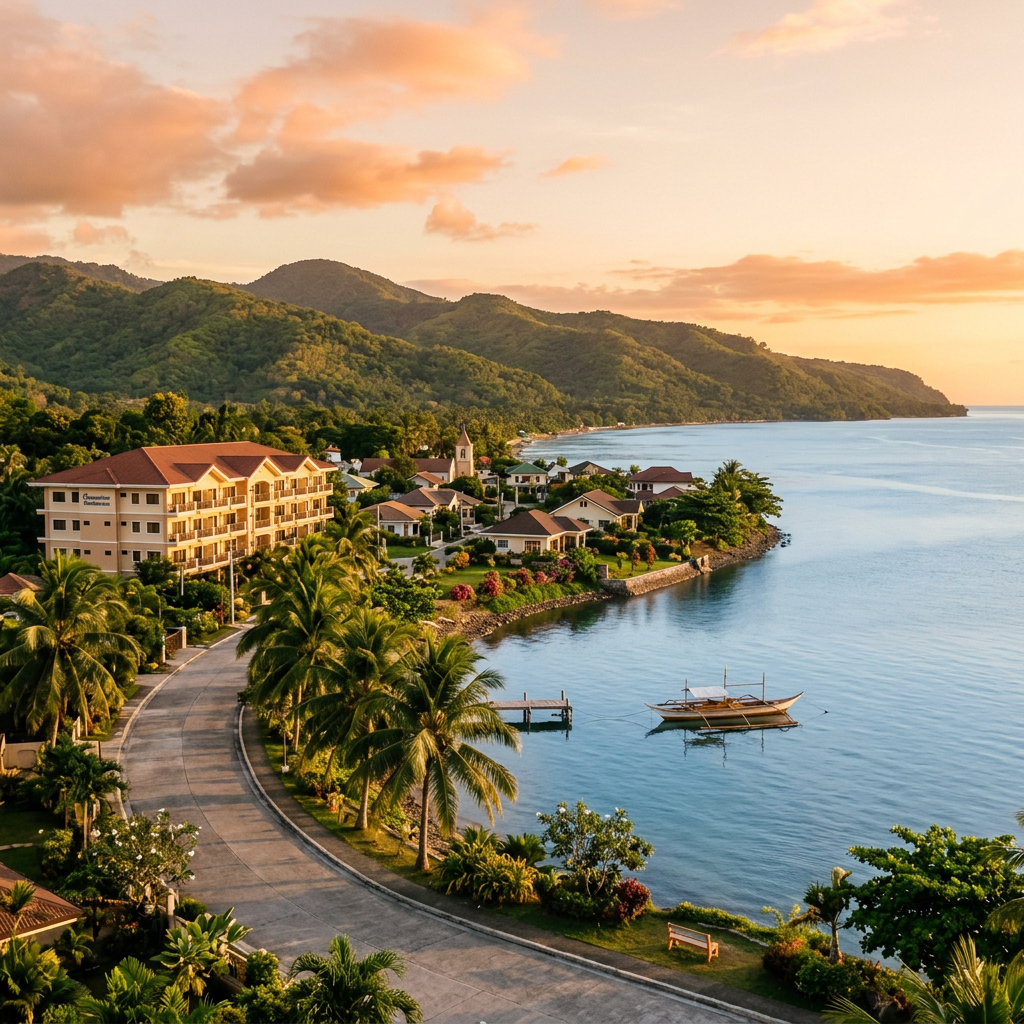
You have $3,000 coming in every month. Maybe it’s Social Security combined with retirement savings. Maybe it’s a pension. Maybe it’s a combination of several income sources.
The question is simple: What kind of retirement can $3,000 a month actually buy you in the Philippines?
The answer is considerably more interesting than saying, “The Philippines is cheap.” If you’re still deciding whether the country fits you, start with our 30-day Philippines test drive.
At current exchange rates, $3,000 represents roughly ₱187,000 per month. That’s substantially more than many Filipinos earn and enough for a single American retiree to live very comfortably in most parts of the country. Even in more expensive areas such as Cebu and Metro Manila, it can provide a good lifestyle if you make sensible choices.
But $3,000 doesn’t make money irrelevant. You can spend it surprisingly quickly if you choose an expensive condo, run air conditioning constantly, eat Western food every day, maintain a car, travel frequently and try to recreate an American lifestyle in the tropics.
So instead of asking whether $3,000 is “enough,” let’s ask the better question.
What does a $3,000 Philippine retirement actually look like?
First, $3,000 Is Not a Budget Goal
This distinction matters.
If you have $3,000 available every month, that doesn’t mean you should spend $3,000 every month.
One of the biggest advantages of retiring somewhere with a lower cost of living isn’t simply that you can afford more things. It’s that you can create margin.
If your comfortable lifestyle costs $2,000 or $2,200, the remaining $800 to $1,000 can become travel money, emergency savings, healthcare reserves or simply money you don’t have to worry about spending.
That financial breathing room may ultimately be more valuable than having the fanciest condo you can afford.
Let’s Build a $3,000 Retirement
Consider a single retiree living comfortably in Cebu, Dumaguete, Iloilo, Bacolod or another popular retirement destination.
A realistic monthly plan might look something like this:
Housing: $600
Six hundred dollars—roughly ₱37,000 at today’s exchange rate—can provide a very comfortable rental in many Philippine cities.
In Cebu, particularly in desirable central neighborhoods, that money may mean a modern one-bedroom condo rather than a large house. Move farther from the most expensive areas or choose a smaller city and the same amount can buy considerably more space.
The important word here is comfortable, not extravagant.
You can certainly spend $1,000, $1,500 or more on housing in the Philippines. But unless the luxury condo itself is an important part of your retirement dream, there may be little reason to do it.
Utilities, Internet and Phone: $200
Electricity is one expense that sometimes surprises new expats.
Air conditioning can significantly affect an electric bill, particularly if you want an American-style indoor temperature around the clock. Internet and mobile service, on the other hand, can be relatively inexpensive.
A $200 allowance provides room for electricity, water, good internet and mobile service while recognizing that heavy air-conditioning use can push the number higher.
Groceries and Household Supplies: $350
This category depends heavily on what you eat.
Rice, vegetables, fruit, chicken, pork and many locally produced foods can be inexpensive. Imported American brands, premium beef, imported cheese, wine and specialty products are another matter.
You don’t have to abandon the foods you enjoy. But an expat who insists on filling the refrigerator with imported products can turn a low-cost grocery country into a surprisingly expensive one.
A $350 budget allows a comfortable mixture of Philippine staples and familiar Western foods.
Restaurants and Entertainment: $300
At this level, retirement doesn’t have to mean cooking every meal at home.
You can eat at local restaurants regularly, visit cafés, have an occasional nicer dinner, meet friends for drinks and enjoy movies or other entertainment without obsessing over every peso.
The danger isn’t the occasional ₱150 lunch.
It’s allowing restaurant dining, nightlife and imported drinks to become an everyday lifestyle expense simply because everything initially seems inexpensive.
Small amounts still add up.
Transportation: $200
One of the easiest ways to keep a Philippine retirement affordable is not owning a car.
Grab, taxis, jeepneys, tricycles and other transportation options can make car ownership unnecessary depending on where you live.
That eliminates the purchase price of the vehicle along with insurance, fuel, maintenance, parking and the experience of driving in Philippine traffic.
Some retirees will absolutely want a car or motorcycle. That’s fine. It simply changes the budget.
For our hypothetical retiree, we’ll assume mostly ride-hailing, taxis and local transportation.
Healthcare and Insurance: $300
This is the category I would be most reluctant to underestimate.
Routine medical care in the Philippines can be considerably less expensive than in the United States, but serious illness is still serious illness. Private hospitalization, surgery and long-term treatment can become expensive.
Healthcare expenses also tend to increase as we age.
The right number will vary tremendously depending on age, existing insurance, whether you use PhilHealth or an HMO, international coverage and how much risk you’re comfortable self-insuring.
For this example, we’re setting aside $300 every month for insurance and routine healthcare costs.
But I’d also want a separate medical emergency fund outside the monthly budget.
We’re Only at $1,950
That’s the part that changes the retirement equation.
Our retiree has spent approximately:
Housing — $600
Utilities/Internet/Phone — $200
Groceries — $350
Restaurants/Entertainment — $300
Transportation — $200
Healthcare/Insurance — $300
Total: $1,950
That leaves approximately $1,050 every month.
And that’s where a $3,000 Philippine retirement becomes much more interesting.
Give the Remaining $1,050 a Job
You could simply spend it.
But I’d divide it.
Perhaps $300 goes into a travel fund. Another $300 goes toward emergency and healthcare reserves. Two hundred dollars covers clothing, household purchases, visa expenses, gifts and all those irregular expenses that don’t conveniently fit into a monthly budget.
That still leaves approximately $250.
Some months you’ll spend it. Some months you won’t.
After a year, even saving just $500 of your unused monthly income would leave you with an additional $6,000 reserve.
That’s what financial breathing room looks like.
What Does Daily Life Look Like?
This is where spreadsheets don’t tell the whole story.
Imagine waking up in a modern condo in Cebu. You make coffee, check the news and decide whether you’re going to cook breakfast or walk downstairs to a café.
Later you take a Grab to meet friends for lunch. You aren’t calculating whether you can afford the ride.
You need groceries, so you stop at a supermarket on the way home. You buy local products where they make sense and throw a couple of imported favorites into the cart without feeling guilty about them.
Your apartment has reliable internet. You use the air conditioner when you want it. You can afford a gym membership or swimming pool. You can go out for dinner several times a week.
A few times a year, you travel.
Maybe it’s a long weekend in Bohol. A week in Palawan. A trip to Manila. Perhaps Thailand, Vietnam, Japan or another nearby Asian destination.
When your refrigerator breaks or you need dental work, the expense is annoying.
It isn’t necessarily a financial emergency.
That’s the difference $3,000 can make.
It’s less about luxury than freedom from constantly thinking about money.
Your City Changes Everything
Three thousand dollars doesn’t create the same lifestyle everywhere.
In Dumaguete, it can support an extremely comfortable retirement. Housing can be considerably less expensive than in the largest metropolitan areas, leaving more money for travel, dining and savings.
In Iloilo or Bacolod, the same principle applies. You can often obtain more space for your housing dollar while still having shopping, hospitals, restaurants and other city conveniences.
In Cebu, $3,000 remains a strong budget, but location matters. A premium condo in a highly desirable development can consume considerably more of the budget.
In BGC or Makati, $3,000 is still workable, but you’re playing a different game. Premium housing, restaurants and an urban lifestyle can push expenses upward quickly.
And in smaller provincial communities, $3,000 may feel like substantially more money than you actually need.
That’s why choosing your Philippine retirement city based solely on “the cheapest place” doesn’t make much sense.
At $3,000 a month, you have choices.
A Couple Can Live on $3,000 Too
A couple doesn’t necessarily need twice the money.
You’re sharing the rent, internet, utilities and many transportation expenses. Cooking for two doesn’t cost twice as much as cooking for one.
Three thousand dollars can therefore support a comfortable retirement for a couple in many Philippine locations.
But the margin becomes smaller.
Healthcare expenses for two people are higher. Travel costs double more quickly than housing costs. Restaurant bills increase. And maintaining a substantial emergency reserve becomes even more important.
A couple living on $3,000 should probably be somewhat more deliberate about housing and recurring expenses than a single retiree with the same income.
The Lifestyle Creep Problem
There is an interesting trap awaiting retirees who arrive with more money than they need.
Everything seems inexpensive.
A Grab ride is cheap.
Dinner is cheap.
A massage is cheap.
Housekeeping is cheap.
Another round of drinks is cheap.
Upgrading the condo is affordable.
So you do all of them.
Eventually, you can build a $4,000 lifestyle in a country where you originally planned to live on $2,000.
The Philippines doesn’t magically make someone good with money.
It simply gives you more room to make choices.
Don’t Build Your Retirement Around Today’s Exchange Rate
As this article is being written in September 2026, the U.S. dollar is unusually strong against the Philippine peso, with $1 recently buying more than ₱62.
That’s wonderful if your retirement income arrives in dollars.
But don’t assume it will always be that way.
Currencies move.
Prices rise.
And the Philippines isn’t immune from inflation. Philippine headline inflation was 6.1 percent in August 2026, while housing, water, electricity, gas and other fuels were up 7.9 percent from a year earlier.
A retirement plan that only works at today’s exchange rate isn’t a very good retirement plan.
That’s another reason not to spend the entire $3,000.
The Expense That Deserves Special Treatment: Healthcare
If you’re retiring at 60 or 65, your healthcare needs at 75 may look very different.
That means a budget shouldn’t merely answer:
Can I afford the Philippines today?
It should also answer:
Can I afford to grow old here?
That’s why I’d rather see someone living happily on $2,000 or $2,200 and protecting the remaining money than spending every available dollar creating the maximum lifestyle today.
The extra money can become your future healthcare fund.
It can pay for better insurance.
It can pay for private hospital care.
It can pay for a flight back to the United States if necessary.
And, as we’ve recently discussed here at Philippine Living Guide, Americans who maintain Original Medicare may also have the option of traveling to Guam or the Northern Mariana Islands for certain Medicare-covered treatment from participating providers.
Your healthcare plan deserves just as much attention as your housing plan.
So, Is $3,000 Enough?
For most single retirees, $3,000 a month can provide a very comfortable retirement in the Philippines.
Not billionaire living.
Not a penthouse, chauffeur and five-star restaurants every night.
Something better.
A nice home. Good food. Air conditioning. Reliable internet. Regular restaurants. Transportation when you need it. Money for healthcare. Trips around the Philippines and Asia. And enough left over that an unexpected expense doesn’t automatically ruin the month.
For a couple, $3,000 can still provide a comfortable life in many parts of the country, although housing choices, healthcare and travel need more careful planning.
The bigger opportunity isn’t discovering everything you can buy with $3,000.
It’s discovering that you don’t have to spend all of it.
If you can build a Philippine life you genuinely enjoy for $2,000 to $2,300 and keep the rest available for travel, healthcare, emergencies and the future, you haven’t simply found a cheaper retirement.
You’ve created something many retirees are really searching for.
Room to live—and room to breathe.
A Note About These Numbers
The figures in this article are examples for retirement planning, not promises about what any particular person will spend. Housing, healthcare, electricity, food and lifestyle costs vary significantly by city, neighborhood and individual choices. Exchange rates also fluctuate. At the time of writing in September 2026, the Philippine peso was trading at roughly ₱62 per U.S. dollar, while Philippine inflation remained elevated.
Before relocating, Philippine Living Guide recommends spending time in your intended city, pricing the lifestyle you actually intend to live and maintaining an emergency reserve separate from your normal monthly budget.
Disclaimer
Philippine Living Guide provides general educational and informational content. Nothing in this article should be considered individualized financial, tax, medical, insurance, immigration or investment advice. Costs, exchange rates, visa requirements and healthcare expenses can change. Readers should verify current information and consult appropriate professionals when making retirement, financial or healthcare decisions.
Leave a Reply