
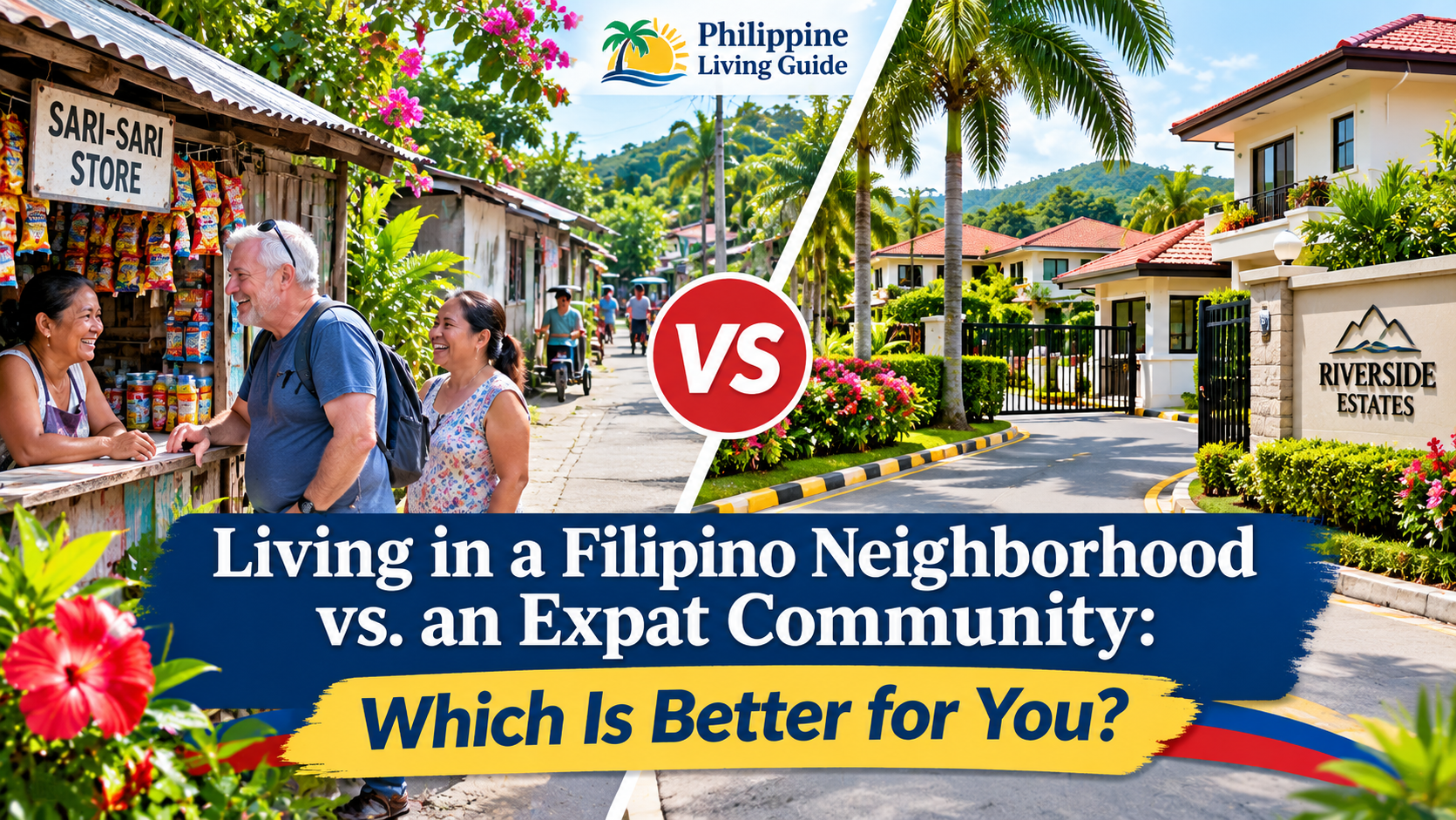
Should you settle into a traditional Filipino neighborhood or choose an area popular with foreign residents? The better choice depends on the life you want—not just the rent.
Picture two mornings in the Philippines. In one, you step outside to greet neighbors, pass a sari-sari store, and hear tricycles starting their daily routes. In the other, you leave a quiet subdivision or condominium, pass a security desk and meet friends for coffee at a familiar café. Either can be a wonderful way to live, but the everyday experience can be surprisingly different.
Americans planning retirement often compare cities—Cebu, Dumaguete, Iloilo or Bacolod—without thinking enough about the neighborhood inside the city. That smaller decision shapes your friendships, spending, independence and daily comfort. Importantly, “Filipino neighborhood” and “expat community” are not official housing categories. Many neighborhoods contain both Filipino and foreign residents, and many gated developments are predominantly Filipino. This article compares common experiences, not rigid stereotypes.

1. What Do These Two Choices Actually Mean?
A Filipino residential neighborhood might be a barangay street with family homes, small businesses, local markets and a mix of renters and owners. An area popular with expatriates might mean a condominium district, a managed subdivision or a neighborhood near international restaurants and social groups. Neither description guarantees a particular level of income, safety, noise or friendliness.
Think in terms of specific streets, buildings and amenities rather than labels. A quiet Filipino neighborhood can be more comfortable than a noisy condominium district, and an internationally oriented neighborhood may be less expensive than a fashionable local subdivision.
2. Housing Costs: The Address Matters More Than the Label
Some ordinary residential areas offer lower rents than condos with security, elevators, pools and association fees. But the gap can disappear in sought-after locations, and a detached house may cost more to maintain than a smaller managed apartment. Furnished units also carry different pricing from unfurnished homes.
Compare the full monthly cost: rent, electricity, water, internet, association charges where applicable, transport, and expected repairs. Ask who pays for air-conditioning maintenance, plumbing problems and appliances. For a broader budget perspective, read Can You Really Live in the Philippines on $1,200–$1,500 a Month?.
3. Friendships: Familiarity Versus Immersion
Living near other foreigners can make it easier to find people who share your language, retirement experience and cultural references. That can be especially helpful during your first months abroad. Yet living primarily within an expatriate social circle may limit how much you learn about local life.
In a neighborhood where most residents are Filipino, everyday conversations can lead to meaningful friendships and a stronger understanding of local customs. Those connections do not appear automatically, however. Be respectful, learn basic greetings, participate appropriately in community life and give relationships time to develop. Neither setting guarantees companionship.
4. Language and Everyday Communication
English is widely used in many Philippine settings, but comfort with English varies by person and location. In Cebu, for example, Cebuano is commonly spoken alongside Filipino and English. You may find that shopkeepers and neighbors switch naturally between languages, especially in local residential areas.
You do not need to become fluent before moving, but learning practical phrases can make ordinary errands easier and show respect. In an internationally oriented condominium or commercial district, English-language services may be easier to navigate, although this is not universal.
5. Privacy, Noise and Neighborhood Routines
Local residential streets may be lively with family gatherings, dogs, motorcycles, vendors, celebrations and neighborhood activities. Some people love that sense of life around them; others find the noise difficult, especially if they work online or sleep early. But condo living can bring its own problems, including hallway noise, nearby construction and restrictions imposed by building management.
Visit any prospective home at different times: weekday morning, late evening and weekend. Check actual sound levels with windows open and closed. Ask about nearby karaoke venues, construction, flooding, waste collection and neighborhood events without assuming that one type of community is automatically quieter.
6. Security: Don’t Assume a Gate Solves Everything
A staffed entrance, cameras and visitor controls may provide useful security features, but they do not eliminate theft, fraud or other risks. Conversely, an ungated residential street may have neighbors who know each other well and notice unusual activity. Neither is a substitute for assessing the specific property and location.
Check lighting, locks, fire exits, flood exposure, emergency access and the reliability of property management. Ask residents about recurring problems. Be cautious about sharing personal financial details in any community. For broader guidance, explore the safety and scams resources on Philippine Living Guide.
7. Transportation and Independence
An affordable home can become expensive if every shopping trip, social event or medical appointment requires a long ride. Some expat-popular areas cluster cafés, supermarkets and clinics; others are car-dependent subdivisions far from public transportation. Traditional neighborhoods may have frequent tricycles or jeepneys but limited pedestrian infrastructure.
Try the journey from the actual front door to the grocery store, pharmacy and hospital. Consider traffic, rain, heat and mobility needs. Our article Living in the Philippines Without a Car explores these trade-offs.
8. Groceries, Restaurants and Familiar Comforts
If you enjoy public markets, local bakeries and neighborhood eateries, an ordinary residential area may suit you well. If imported groceries, specialty coffee, Western restaurants or international social clubs are priorities, living near commercial centers can save time and transportation expenses.
Neither choice forces a particular diet. You can cook American comfort food with Philippine ingredients or enjoy Filipino meals wherever you live. What matters is whether your preferred stores and services are genuinely accessible, not simply advertised as nearby.
9. Healthcare Access Is More Important Than the Community Label
For older retirees and people with ongoing medical needs, access to appropriate healthcare should outweigh the appeal of a fashionable neighborhood or a cheap rental. A beautiful house may be impractical if the nearest suitable emergency department is difficult to reach.
Map the hospitals you might use, check emergency transport arrangements and test travel times. Living alone makes a reliable local contact particularly valuable. Read our recent guide, What Happens If You Have a Medical Emergency While Living Alone in the Philippines?, for preparation ideas.
10. Relationships, Boundaries and Expectations
Social dynamics differ from household to household. Some residents experience warm invitations and a strong sense of community; others prefer more personal space. In expatriate circles, newcomers may find quick introductions, but they can also encounter gossip or pressure to spend money keeping up with friends.
Be friendly without making assumptions about what neighbors expect from you. Set clear boundaries around loans, gifts and financial help in every social setting. Good relationships grow from mutual respect, not from trying to purchase acceptance.
11. A Mixed Neighborhood May Be the Best Compromise
Many retirees discover that the most comfortable arrangement is neither an isolated expat enclave nor a place where they struggle with every daily errand. A mixed neighborhood near transport, hospitals and shops can offer opportunities for local friendships along with practical conveniences.
Rather than asking where foreigners live, ask where people with your habits and needs can live well. A quieter side street near a busy commercial district may offer more value than either extreme.
Side-by-Side: What to Compare Before You Rent
| Factor | Local neighborhood: check | Expat-popular area: check |
|---|---|---|
| Housing | Total rent and maintenance | Total rent, dues and amenities |
| Social life | Local relationships and neighborhood routines | Ease of meeting other foreigners |
| Language | More opportunities to practice local languages | Potentially easier access to English-speaking services |
| Noise | Street activity varies block by block | Building and subdivision noise varies |
| Transport | Check tricycles, jeepneys and walkability | Check whether a car or rides are necessary |
| Security | Inspect the specific street and home | Inspect management and actual safeguards |
| Healthcare | Verify real travel time | Verify real travel time |
This table highlights questions to investigate, not universal differences. Individual properties and neighborhoods may reverse any general pattern.
A Practical Two-Week Neighborhood Test
Before signing a long lease, consider staying nearby for one or two weeks if your circumstances permit. Use the same grocery stores, transportation, cafés and medical facilities you would use as a resident. Observe the neighborhood in the rain and after dark. Speak with residents who are not involved in renting you the property.
- Visit the exact street on a weekday and weekend, morning and evening.
- Check water pressure, mobile reception, internet options and power reliability.
- Test transport to a hospital, grocery store and pharmacy.
- Ask what the rent includes and who pays for repairs or association dues.
- Observe noise, drainage, security and accessibility.
- Notice whether you can imagine an ordinary Tuesday there—not just a vacation weekend.
Who Might Prefer Each Option?
A local Filipino neighborhood may appeal to you if you enjoy community interaction, want to learn local routines, shop at markets and are comfortable adapting to unfamiliar surroundings. An expat-popular area may appeal to you if you value easy access to familiar services, established social networks or managed building amenities. Neither is inherently more authentic or more suitable for retirement.
For couples with one Filipino spouse, the choice may also depend on family proximity, work, shared preferences and responsibilities. For a single retiree, nearby trusted contacts and accessible healthcare may deserve extra weight. The best home is the one that works for everyone living in it.
The Bottom Line
Choosing between a Filipino neighborhood and an expat community is not a contest between two ways of life. It is a decision about the daily routine you want to build. The right answer may be a local street, a condo near other foreign residents or a mixed community that offers a bit of both.
Before committing, rent first when possible, test the neighborhood in person and prioritize healthcare access, mobility, safety and financial sustainability. A retirement destination is more than a scenic city on a map. It is the place where you will buy groceries, sleep, make friends and live an ordinary day.
For related planning, see The Hidden Costs of Moving to the Philippines and The Ultimate Moving to the Philippines Checklist.
Reader question: Would you rather live in a traditional Filipino neighborhood, an area with many foreign residents or a mix of both? What has your experience been?
Disclaimer: Housing conditions, transport, security, healthcare access and living costs vary by property and location. This article offers general lifestyle guidance, not a guarantee about any specific community. Verify conditions and contract terms before making a housing decision.
Leave a Reply